ZAGREB, Croatia (September 15) -- The World Championships day three will see the start of Women's Wrestling in Zagreb. Two weight classes -- 55kg and 59kg -- will be in action. Freestyle will continue in 65kg and 97kg with two Olympic champions in action.
WATCH LIVE | LIVE MATCH ORDER | DAY 2 RESULTS
65kg semifinals
SF 1: Rahman AMOUZAD (IRI) vs Piabani (CAN)
SF 2: Kotaro KIYOOKA (JPN) vs. Umidjon JALALOV (UZB)
14:56: Peiman BIABANI (CAN) comes back from a 2-0 down to beat Andrii BILIICHUK (UKR) in the 65kg quarterfinals. Biabani scored three stepouts and a takedown to take the lead and held on to it to win the quarterfinals.
14:55: SUJEET (IND) gave it all against Olympic silver medalist Rahman AMOUZAD (IRI) in the 65kg quarterfinals but Amouzad got a takedown in the final 20 seconds to be safe. Amouzad scored four stepout to lead 4-0 but struggled with conditioning. Sujeet scored a takedown and stepout to make it 4-3. Needing only one to win, Sujeet committed to a far leg attack and Amouzad countered with a takedown to make it 6-3. Sujeet scored a takedown with 4 seconds on the clock but could not get one point for the win. Amouzad reaches semifinal with a 6-3 win.
14:52: Olympic champ Kotaro KIYOOKA (JPN) fires out at the gun in his 65kg quarterfinal against Ibragim IBRAGIMOV (UWW), grabbing a single leg, snatching the other ankle and going straight to a lace-lock roll. The action, however, is so fast he is given just 2 points, which proves enough as he fends off Ibragimov to post a 3-0 victory. Kiyooka's final point came on an unsuccessful challenge after the buzzer when Ibragimov's side tried to get the Japanese penalized for fleeing, but the judges ruled he properly defended.
14:51: Umidjon JALOLOV (UZB) breaks open a close match with a pair of takedowns in a 20-second span of the second period, then holds on for a 5-3 victory over Sebastian RIVERA (PUR) to advance to the 65kg semifinals. Jalolov held the criteria advantage after both had received an activity point, but scored a takedown at with 1:20 left, then added another a short time later. Rivera picked up a takedown with :22 to go, but it was too little, too late.
55kg semifinals
SF 1: Sowaka UCHIDA (JPN) vs. Kyong Ryong OH (PRK)
SF 2: Ekaterina VERBINA (UWW) vs. Andreea ANA (ROU)
14:41: Kyong Ryong OH (PRK) uses her lace to great effect to deny any comeback from Elvira KAMALOGLU (TUR) in the 55kg quarterfinals. Oh manages to go past Kamaloglu 14-7
14:40: Sowaka UCHIDA (JPN) reaches the 55kg semifinals after beating Oleksandra KHOMENETS (UKR) 10-5. It was a takedown masterclass from Uchida who led 8-0 before Khomenets had a big four pointer. But Uchida kept her cool and managed to win 10-5.
14:39: Andreea ANA (ROU) runs 2022 world bronze medalist Karla GODINEZ (CAN) out of the ring in the final minute for a stepout with a fleeing point tacked on, putting her into the 55kg semifinals with a 3-1 victory. Each wrestler had received an activity point, with the Canadian holding the last-point criteria.
14:39: European champion Ekaterina VERBINA (UWW) scores three takedowns, which is enough to trump the 4-point takedown that Yaynelis SANZ VERDECIA (CUB) chalked up and temporarily put her in the lead. Verbina walks away with a 6-4 victory in the 55kg quarterfinal, in which all of the points came in the first period.
59kg semifinals
SF 1: Altjin TOGTOKH (MGL) vs. Sakura ONISHI (JPN)
SF 2: Laurence BEAUREGARD (CAN) vs. Maria VYNNYK (URK)
14:30: Elena BRUGGER (GER) and Altjin TOGTOKH (MGL) trade takedowns in the second period but Brugger leads 3-3 on criteria with a 2 minutes left. She makes it 5-3 with a takedown before two lace turns make it 9-3 with 1 minute left in the match. BUT TOGTOKH WITH A BIG MOVE AND FALL! She beats Brugger despite the latter leading 9-5 and advances to the 59kg semifinals.
14:26: After spotting Bediha GUN (TUR) a four-point lead, Laurence BEAUREGARD (CAN) comes back to go ahead on criteria in the second period, only to fall behind again. But Beauregard comes up with a late takedown to win 6-6 on criteria and earn a spot in the 59kg semifinals.
14:25: Mariia VYNNYK (UKR) hits the move of the day in the women's competition, tossing Othelie HOEIE (NOR) for 5 with a high-amplitude back suplex en route to a 11-0 victory to advance to the 59kg semifinals.
14:20: Sakura ONISHI (JPN) with an inside trip and the fall over Anastasiia SIDELNIKOVA (UWW) after a 12-0 lead. She advances to the 59kg semifinal and a step closer to the first senior world title. She is a two time world U20 champion, the second coming just a month ago in Samokov, Bulgaria.
97kg semifinals
SF 1: Akhmed TAZHUDINOV (BRN) vs Amirali AZARPIRA (IRI)
SF 2: Arash YOSHIDA (JPN) vs. Kyle SNYDER (USA)
14:15: Olympic champion Akhmed TAZHUDINOV (BRN) survives a huge scare against Magomed KURBANOV (UWW) in the 97kg quarterfinals. Kurbanov threated to run away with it when he began with two stepouts to lead 2-0. He made it 4-0 with a takedown but Tazhudinov got going in the second period with a takedown to cut the lead to 4-2. He used a front headlock move to score six more points to lead 8-2. A challenge, which was lost, from Kurbanov made it 9-4. But Kurbanov got a breather and then got a takedown to make it 9-6. In the final 15 seconds, he managed a front chestwrap exposure but Tazhudinov got a reversal as the score changed to 10-8. Tazhudinov gave up a stepout but still managed to win 10-9.
14:10: Young Arash YOSHIDA (JPN) puts on an impressive display of power, scoring five stepouts in bulling to a 6-2 victory over Olympic silver medalist Givi MATCHARASHVILI (GEO) to advance at 97kg. Yoshida's other point came on a rare reversal after he gave up a takedown. That sets up a rematch with Snyder of their semifinal encounter at the Tirana Ranking Series event in February won 5-5 by the Japanese.
14:09: Kyle SNYDER (USA) provides no openings for Zbigniew BARANOWSKI (POL) in their 97kg quarterfinal as the seven-time world medalist post a workmanlike 5-0 victory comprised of a takedown, two stepouts and an activity point.
14:05: The first semifinalist at 97kg is Olympic bronze medalist Amirali AZARPIRA (IRI) who beats VICKY (IND) 10-0 in 3:30. A blast double in that match from Azarpira for four points.
13:55: Kotaro KIYOOKA (JPN) spends much of his 65kg match trying to chase down the elusive Ayub MUSAEV (BEL), but he manages to snatch an ankle enough to score three takedowns, with one thigh-lock roll added in for a 9-4 victory. There was one lapse of caution, when Kiyooka was thrown for 4 on a counter lift, but was otherwise in no danger.
13:40: Real WOODS' (USA) got on point in his match against Olympic silver medalist Rahman AMOUZAD (IRI) and that was for a lost challenge from the Iranian. Otherwise, Amouzad showed why his underhooks are lethal, scoring 10 points from the move to win 12-1. A stepout and point for lost challenge from the United States were the other two points.
13:36: Three-time former European champion Andreea ANA (ROU) chalks up a 4-point move in the first period and two stepouts in the second and she's through to the 55kg quarterfinals with a 6-3 victory over 2024 world U20 champion Cristelle RODRIGUEZ (USA).
13:35: World silver medalist Sebastian RIVERIA (PUR) rolls to a 10-0 technical superiority win over Goderdzi DZEBISASHVILI (GEO) to secure his place in the 65kg quarterfinals.
13:28: SUJEET (IND) with a typical hard-working win over Kwang Jin KIM (PRK) at 65kg. A lot of stepout given up by a tired Kim. Sujeet into the quarterfinals.
13:25: Asian champion Kyong Ryong OH (PRK) looks like one to beat at women's 55kg as she storms to a 12-2 victory over Mihaela SAMOIL (MDA) to advance to the quarterfinals. Oh has a reply to all of Samoil's counter moves, and her victory in 2:36 includes a 4-point takedown off a double leg.
13:25: European champion Ekaterina VERBINA (UWW) with a fall over veteran Oleksandra KOGUT (AUT) at 55kg. Verbina is looking to win a first world medal at the senior level and she looks good to do it.
13:13: World silver medalist Oleksandra KHOMENETS (UKR) warms up with a 10-0 technical superiority win over Hyerim LEE (KOR) at 55kg. Khomenets is looking find her old form after returning from an injury.
13:12: Less than a month after winning a second straight world U20 gold, Sakura ONISHI (JPN) begins her quest for a title in her senior world debut with a 10-0 rout of Laylokhon SOBIROVA (UZB) at 59kg.
13:09: European champion and Olympic silver medalist Givi MATCHARASHVILI (GEO) eases by Shatlyk HEMELYAYEV (TKM) 4-0 in his opening match at 97kg as he looks to improve on his two career world bronze medals. A takedown in the first period and activity points in each half were all he needed.
13:10: Sowaka UCHIDA (JPN) holds on to her 8-4 lead and beats NISHU (IND) at 55kg to advance to the quarterfinals at the World Championships. This is her debut at the senior level
12:59: Asian champion Arash YOSHIDA (JPN), looking to give Japan a rare medal in the upper weights, continues his run with a 10-0 victory over Ertugrul AGCA (GER) at 97kg. Yoshida, whose father is Iranian and runs the kids club in Japan where he started the sport, scores a takedown and lace-lock roll in the first period, then finishes up the match with three takedowns in the second.
13:00: Pyol HONG (PRK) and Elena BRUGGER (GER) waited and waited for some action. Brugger took a 2-1 lead when Hong was on the second activity period and did not score. In the final 10 seconds, Hong locks Brugger's arms and throws her for two points and wins 3-2. Germany challenges the call. There was no danger for Brugger in that throw and the scores are reversed to 2-1 and a victory for Brugger at 59kg.
12:53: In a contentious match at 97kg that included penalty points and a dressing down of both wrestlers from the match chairman, Olympic bronze medalist Amirali AZARPIRA (IRI) comes away with a 6-3 victory over Akhmed MAGAMAEV (BUL).
12:42: Kyle SNYDER (USA), a 10-time world and Olympic medalist, begins his quest for an 11th one with a 10-0 victory over Cristian SARCO (VEN) at 97kg. He missed out on a medal in Paris, the first World or Olympics since 2015 that he failed to win a medal.
12:40: Kotaro KIYOOKA (JPN), competing internationally for the first time since his triumph at 65kg at the Paris Olympics -- with a new, braided hair style -- opens with a 13-2 victory over Alibeg ALIBEGOV (BRN). It is Alibegov who strikes first, surprising the Olympic champion with a quick double-leg takedown. But Kiyooka replies with a single-leg takedown, then transitions to his patented thigh-lock with the head between the legs and rolls twice for a 6-2 lead. He adds a stepout before the buzzer. Kiyooka stays on the attack in the second period and gains a takedown and two traditional lace-lock rolls to end the match in 4:59.
12:32: Paris Olympic and 2023 world bronze medalist Sebastien RIVERA (PUR)appears to wake up after giving up an early stepout to Chouaib SAHRAOUI (ALG) at 65kg. He comes back with a takedown, then goes on a gut wrench spree to make it 12-1, at which point Sahraoui throws in the towel and it officially goes into the books as a fall at 1:57.
12:30: World and Olympic champion Akhmed TAZHUDINOV (BRN) faces Magomedgadji NUROV (MKD) in his first match at 97kg. He begins with a takedown and stepout to lead 3-0. A blast double for four to make it 7-0. Two points for exposure to make it 9-0 before he finishes the match with a stepout.
12:29: Budpest Ranking Series champion SUJEET (IND) storms out to a quick 6-0 lead against Cavit ACAR (TUR) at 65kg, but it suddenly begins to evaporate as Acar scores a pair of defensive exposures and the exchange reversals. That puts Sujeet up 7-5 at the break. But he pulls away in the second period, with a 4-point takedown when Acar attempts a reverse counter lift and an unsuccessful challenge gives Sujeet a 15-5 win.
12:25: Vazgen TEVANYAN (ARM) was leading 5-0 but Abdulmazhid KUDIEV (TJK) hit a takedown and rallied a leg-lace to win to win 16-5. Tevanyan seems in some trouble with his knee. Armenia challenges and the last turn is removed. But down 14-5, Tevanyan managed only three more points as Kudiev wins 14-8.
12:18: Olympic silver medalist Rahman AMOUZAD (IRI) wastes little time in getting his campaign for a second career world gold at 65kg off to roaring start, using a 4-point takedown to finish off a 13-0 whitewash in just under two minutes. over Ikromzhon KHADZHIMURODOV (KGZ).
12:15: Ibragim IBRAGIMOV (UWW) controls his bout against Gantulga BATBAATAR (MGL) throughout the six minutes to win 12-0 and advance at 65kg. Ibragimov is trying to win his first world medal
11:54: Real WOODS (USA) gives no chance to Maxim SACULTAN (MDA) in his 65kg opening bout. Woods with a gut-wrench to rack up those points but he wins 11-0
11:38: A victory for the Philippines. In a battle between wrestlers from countries trying to develop the sport, American-born Arian CARPIO (PHI) defeats Victoria CHHEN (AUS) 7-0 to advance at women's 59kg. Carpio, who competed for the U.S. until 2019, scores a takedown-lack lock combination and stepout in the first period, then caps the win with a second-period takedown.
11:35: Seems like Sowaka UCHIDA (JPN) has recovered from an ankle injury she picked at the U20 World Championships. She starts her 55kg campaign with a 10-0 victory over Khulan BATKHUYAG (MGL)
11:20: Paris Olympic bronze medalist Amirali AZARPIRA (IRI) matches 2023 Asian Games bronze medalist Gankhuyag GANBAATAR (MGL) with an activity point and stepout, but both of his come in the second period and that gives the Iranian a 2-2 victory on last-point criteria at 97kg.
11:20: Jacarra WINCHESTER (USA), a world 55kg champion in 2019, moved up to 59kg for this World Championships but Hong LIANG (CHN) shows Winchester that there are different levels to this. She pins Winchester
11:14: Asian champion Arash YOSHIDA (JPN) picks up a first-period fall against Domantas PAULIUSCENKO (LTU) at 97kg, a weight class that is absolutely packed
11:10: In the first of many high-profile matchups to come in the super-stacked 97kg division, 2023 world 92kg champion Rizabek AITMUKHAN (KAZ) gives up a takedown and the lead with just under two minutes left to Magomed KURBANOV (UWW), the 2021 silver medalist at 92kg. But Aitmukhan gets behind off a scramble with :48, then adds a stepout. But a second apparent stepout with :08 left is overturned on challenge and awarded to Kurbanov, suddenly giving him a 4-4 lead on criteria. A last-ditch challenge at the end is denied, giving Kurbanov a 5-4 win.
10:58: Asian bronze medalist Kwang Jin KIM (PRK) gets a first-period takedown and that holds up for a 2-0 victory over Junsik YUN (KOR) to clear his first hurdle at 65kg.
10:50: A match marred with multiple medical timeouts, Olympic bronze medalist and world silver medalist Magomedkhan MAGOMEDOV (AZE) has to be carried off the mat after he called for an injury. Magomedov and VICKY (IND) battled it out and the India wrestler led 5-0 before Magomedov woke up. The score was 9-7 with Vicky leading but Magomedov scored a takedown and turn to lead 11-9. But he failed to recover for a restart and the match was decided with Vicky as winner.



 The coach's course in Amman. (Photo: United World Wrestling)
 A competition was held after the completition of both the courses. (Photo: United World Wrestling)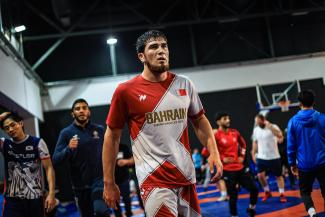
Share your thoughts.
Comments