ALEXANDRIA, Egypt (May 2) -- Dunia SIBOMANA (COD) was six years old when, in an instant, his childhood was shattered.
While playing with his brother and cousin at the Virunga National Park in the Congo, the three boys were attacked by chimpanzees. His brother and cousin did not survive. Dunia did, but just barely. The attack left him with devastating injuries to his lips, face, and right ear. Much of the muscle in his face was destroyed, and he lost the middle finger of his left hand. Yet from that unimaginable tragedy, a story of resilience began to take shape - one that saw rise to claim two golds at the African Championships in Alexandria.

At just eight years old, Dunia was brought to the United States for a chance at rebuilding what had been taken from him. What followed was a long and gruelling journey through 14 intensive surgeries, where doctors painstakingly grafted tissue and muscle in an effort to reconstruct his lips and restore basic function to his face. Each procedure was another battle, each recovery another test of endurance.
During his time in the United States, Dunia lived with two host families before finding a permanent home with Long Beach assistant wrestling coach Miguel Rodriguez and his wife, Marissa. What began as care turned into something deeper. They adopted him, giving him not just stability but a family. In 2019, Dunia officially became a permanent U.S. resident.
That possibility found its outlet on the wrestling mat. Dunia emerged as a force in middle school and continued to rise through the ranks at Long Beach High School. His determination, forged through years of hardship, translated into a relentless drive. At just 14 years old, he captured the New York State Division 1 wrestling championship title in 2022, a stunning achievement that marked him as one of the sport’s brightest young talents.
On Saturday, Dunia’s journey reached another defining moment. Competing at 57kg for his birth nation, Congo, he claimed the gold medal with commanding authority. He opened with a tense 3-2 victory over Alaa ELSAYED (EGY), then surged past Mouadh CHIBANI (ALG) with a dominant 12-2 semifinal win. In the final, he needed just 51 seconds to overwhelm Roland NFORSONG (CMR), sealing a 10–0 technical superiority victory.
Dunia’s march to the top of the podium was even more remarkable because he was one of the two wrestlers in Freestyle not from Egypt or Algeria to win the gold medal. The other wrestler who put the brakes on Egypt’s dominance was Harrison ONOVWIOMOGBOHWO (NGR), who defeated Mohamed SALAHELDIN (EGY) 10-4 to win the gold medal in the 97kg category.
These two results, however, did not stop Egypt from running away with the team title. The host-nation wrestlers reigned supreme in six out of the 10 categories, winning gold medals in the 61kg, 65kg, 70kg, 74kg, 92kg and 125kg weight classes. Algeria were second best, claiming top-of-the-podium finishes at 79kg and 86kg divisions.
Hassan ELSAYED (EGY) started the fireworks for the hosts by defending his title at 61kg. He started with a flawless 12-0 win over Saviour EGOLI (NGR), then beat Rabby KILANDI (COD) on superiority in the second round. He maintained his unbeaten record by defeating Tadeu DE DEUS (ANG) in the third round and entering the semifinals, where he defeated Mustapha BATNINI (TUN) 11-0. In the final, Elsayed beat Abdelghani AID (ALG) 9-1 to win the title.
Shehabeldin MOHAMED (EGY) took just two minutes to pin Stephen AKINTEWE (NGR) in the 65kg final to claim the title. He used a perfect over-under to throw Akintewe and secure the fall. Soon after, Mohamed AHMED (EGY) was even quicker to win the 70kg final against Wotna NDOC (GBS), 12-1, rolling him using the gut-wrench to win in just 1:02 minutes and upgrading his 2025 silver to gold.
Defending champion at 74kg Omar MOURAD (EGY) managed to retain his gold medal after winning the final against Ebierelayefa ANDREW (NGR) in just 1:13. Mourad used a counter front headlock to throw Andrew over and then pinned the Nigerian used a double-arm lock.
Ahmed MOHAMED (EGY) added the fifth gold medal, beating Walid CHEIKH LAHLOU (MAR), 12-0, in the 92kg final. He used an arm-throw to score four points, then a fireman carry to get two more and lead 6-0. He could not pin Lahlou but got two more points for exposure. A second arm-throw gave him four more points and win the final via technical superiority.
In the round-robin bracket at 125kg, Abdelrahman SHEYATAN (EGY) won all four of his bouts in dominant fashion to claim the gold medal. He won his first bout against Joel TOKAI (KEN), 10-0, pinned Issah FUSEINI (GHA), got a forfeit in Round 4 and then pinned Laid KHELIF (ALG), the eventual silver medalist, in Round 5.
At 79kg, Abdelkader IKKAL (ALG) managed to defended his gold medal at the expense of Mohamed ABDELHADY (EGY), winning the final 10-0. A stepout opened the scoring for Ikkal who then scored a takedown using a leg-attack before lacing Abdelhady for a turn to lead 5-0. He tripped the Egyptian for two more points before an easy takedown made it 9-0. He finished the final with a stepout to win just before the break.
Fateh BENFERDJALLAH (ALG) reclaimed the 86kg title after three years, beating Gabriel MC DUFFIE (SLE), 12-0 in the final. He used two beautiful arm throws to score eight points and two turns for two points each. Despite the loss to Benferdjallah, McDuffie can be proud that he is the first-ever Freestyle silver medalist for Sierra Leone at the African Championships.

RESULTS
57kg
GOLD: Dunia SIBOMANA (COD) df. Roland TAMBI NFORSONG (CMR), 10-0
BRONZE: John LEOPOLD (MRI) df. Makaya KATENDI (ANG), 9-1
BRONZE: Mouadh CHIBANI (ALG) df. Alaa ELSAYED (EGY), 11-7
61kg
GOLD: Hassan ELSAYED (EGY) df. Abdelghani AID (ALG), 9-1
BRONZE: Saviour EGOLI (NGR) df. Mustapha BATNINI (TUN), 5-5
65kg
GOLD: Shehabeldin MOHAMED (EGY) df. Stephen AKINTEWE (NGR), via fall
BRONZE: Raby BAPELEKIA (CGO) df. Gilbert MWAMBA (ZAM), 11-0
BRONZE: Oussama LARIBI (ALG) df. Gabriel YANGA (COD), 10-0
70kg
GOLD: Mohamed AHMED (EGY) df. Wotna NDOC (GBS), 12-1
BRONZE: Khaireddine BEN TLILI (TUN) df. Mourad SAAD (MAR), via forfeit
BRONZE: Dideikemei EREFAGHA (NGR) df. Elie DJEKOUNDAKOM DJERAYOM (CHA), 12-0
74kg
GOLD: Omar MOURAD (EGY) df. Ebierelayefa ANDREW (NGR), via fall
BRONZE: Abderrahmane BENAISSA (ALG) df. Jacques MONTY MBOUGOU (CMR), 5-2
BRONZE: Caetano ANTONIO SA (GBS) df. Omar LAMBARRAA (MAR), 7-5
79kg
GOLD: Abdelkader IKKAL (ALG) df. Mohamed ABDELHADY (EGY), 10-0
BRONZE: Solomon ULABO (NGR) df. Totiana RAZAFINJATO (MAD), via fall
BRONZE: Andy MUKENDI (COD) df. Mohammed BOUAZOUNI (MAR), 10-0
86kg
GOLD: Fateh BENFERDJALLAH (ALG) df. Gabriel MC DUFFIE (SLE), 12-0
BRONZE: Mohamed EL MEKKAOUI (MAR) df. Persy BAMONA (COD), via fall
BRONZE: Matteo MONTEIRO FURTADO TRESSE (CPV) df. Bouba SALEH (CHA), 10-3
92kg
GOLD: Ahmed MOHAMED (EGY) df. Walid CHEIKH LAHLOU (MAR), 12-0
BRONZE: Kevin MOSSE (BUR) df. Tiwisna BAMBA (CHA), via fall
97kg
GOLD: Harrison ONOVWIOMOGBOHWO (NGR) df. Mohamed SALAHELDIN (EGY), 10-4
BRONZE: Wali KEBIR (ALG) df. Cedric ABOSSOLO (CMR), via inj. def.
125kg
GOLD: Abdelrahman SHEYATAN (EGY)
SILVER: Laid KHELIF (ALG)
BRONZE: Issah FUSEINI (GHA)



 Participants pose for a photo after the conclusion of The South-East Asia & Oceania Education Week. (Photo: United World Wrestling)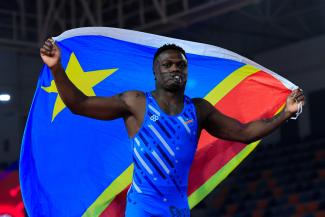
Share your thoughts.
Comments