On Thursday, Kim became the latest to fall victim to the Motoki magic. The Japanese took a 3-0 lead in the first period on an activity point and a sweeping single-leg takedown.
Trying to defend in the second period, Motoki gave up a single-leg takedown to Kim, which the Japanese was willing to concede. But she wasn't prepared for being
gut-wrenched over to suddenly fall behind 4-3 with :35 left.
"I had a three-point lead and when she got in on a single leg, I thought it would be alright to give up two [points]," Motoki said. "But then when I was rolled, I thought, 'This is bad. Once again I'm going to get this far and not win?'"
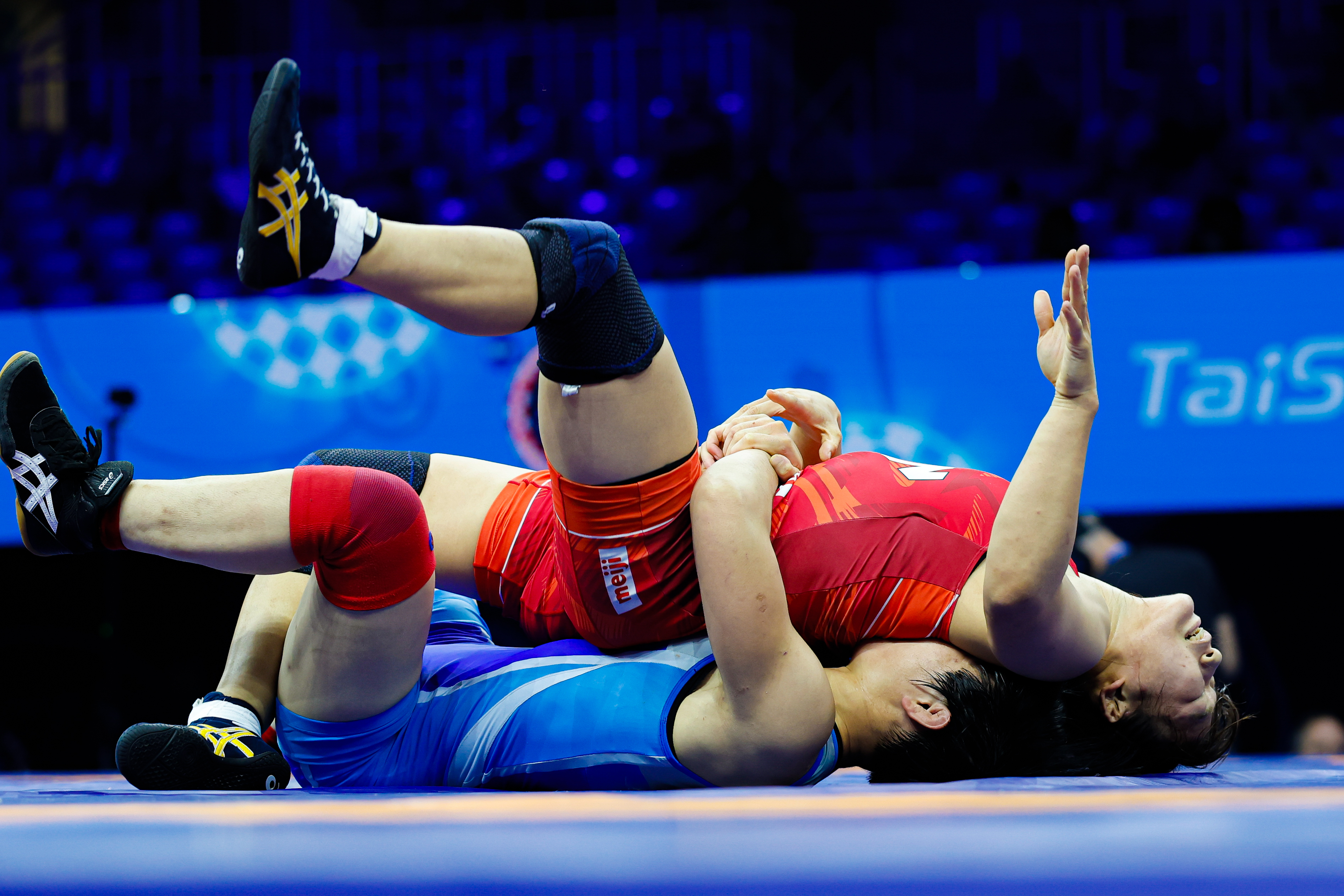 Ok Ju KIM (PRK) turns Sakura MOTOKI (JPN) to take a 4-3 lead in the 62kg final. (Photo: United World Wrestling / Kostadin Andonov)
In her two previous trips to the World Championships, Motoki fell short of the gold, taking the bronze in 2022 and the silver in 2023, losing to Aisuluu TYNYBEKOVA (KGZ) in the final. Would she miss out on the gold again?
With 12 seconds left, she launched her attack, transitioning from one thing to another in a desperate attempt. First a low single, then an arm throw, then back to
a single. All were defended. Then she tried a headlock throw, and that sent Kim sideway to the mat as time ran out.
The referee gave no points, but on challenge, it was determined that Kim's shoulders broke the 90-degree plane -- with :00.3 seconds on the clock.
"In the last 12 seconds, I launched an attack, and when the tackles failed, I thought, 'Oh no, that's the end,'" Motoki said. "When I looked back, she was on my back. I thought if I threw her, I could make it. I just put everything into the throw, but I didn't know if I turned her. Really, it was lucky."
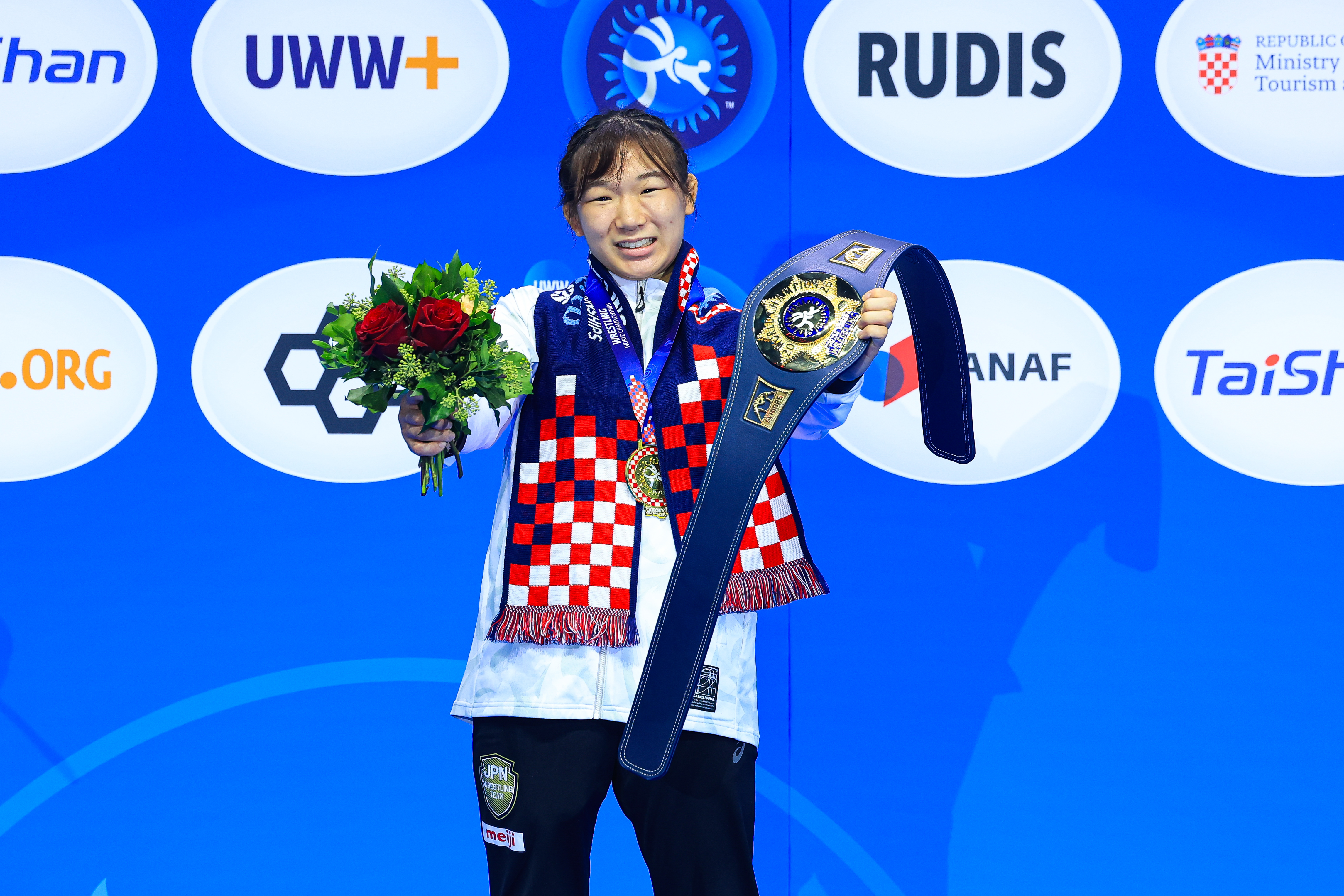 Sakura MOTOKI (JPN) won her first world gold medal in Zagreb. (Photo: United World Wrestling / Kadir Caliskan)
Motoki said her earlier losses at the worlds served as incentive to work harder and always give everything up to the final whistle. She told the Japanese press earlier this year that she uses the UWW music played during the medal ceremony as her morning alarm -- a constant reminder of the agony she never wanted to experience again.
"Three years ago and two years ago, I lost on this stage, and the feeling of disappointment and of being inferior, even after winning at the Olympics, did not go away," Motoki said. "But by losing, it made me stronger and made me what I am now. To win here makes me so happy."
Motoki will embark on another quest in a month's time when she competes at the World U23 Championships on October 20-27. Already a world U17 and U20 champion, a victory in Novi Sad, Serbia, will make her just the third member -- along with Yui SUSAKI (JPN) and Amit ELOR (USA) -- of the elite "Golden Grand Slam" club, those who have won on the senior and all three age-group levels as well as at the Olympics.
"One might think that winning on the age-group level would put you at the forefront, but that's not the case," Motoki said. "After I won the U17, I had an injury and became weaker. I lost in the first round at the Inter High. Then I went to college and thought I had progressed, only to have a major injury.
"To achieve the Grand Slam would be due to overcoming the hard times with the support of many others."
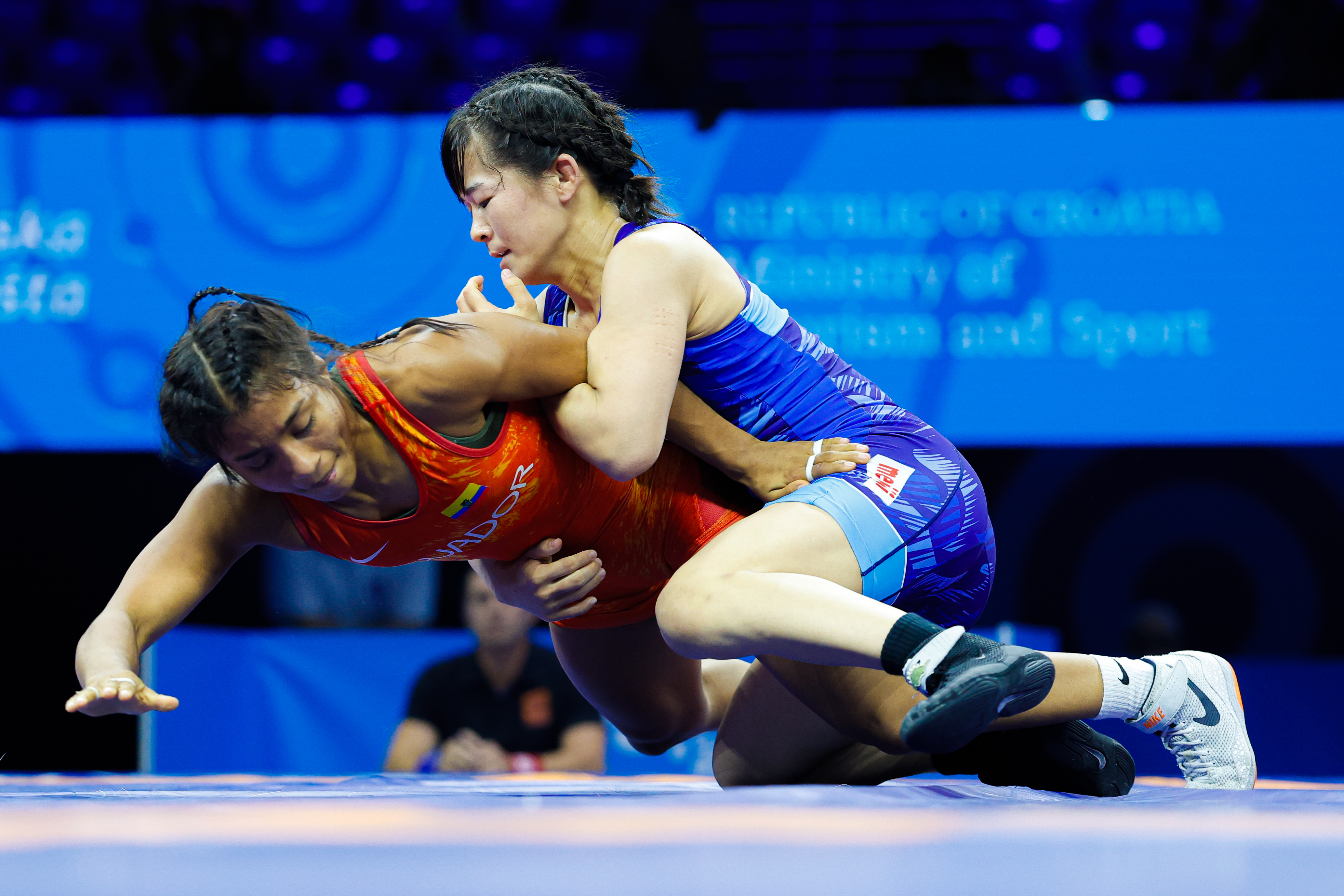 Haruna MURAYAMA (JPN) controls Lucia YEPEZ (ECU) during the 53kg final at the World Championships. (Photo: United World Wrestling / Kostadin Andonov)
At 53kg, Murayama established herself as the frontrunner in the weight class in the runup to the 2028 Los Angeles, following the decision by Paris gold medalist Akari FUJINAMI (JPN) to move up to 57kg.
Murayama scored takedowns in each period to defeat Paris silver medalist Lucia YEPEZ (ECU) 5-0 and add to her world golds from 2017, 2018 and 2023, all won under her maiden name of OKUNO.
It marks the continuation of a remarkable turnaround for Murayama, who sank into the depths of despair after losing out on the berth for the Tokyo Olympics to collegiate teammate and eventual gold medalist Mayu MUKAIDA (JPN).
"I had half given up on the idea of competing at events like the World Championships in an Olympic weight class," Murayama said. "So just being able to stand on this stage and leave this kind of result behind -- it’s something that two or three years ago, I couldn’t even have imagined."
It was Yepez who famously scored seven points off Fujinami in the quarterfinals at the 2023 World Championships, albeit the Japanese came back and scored 16 of
her own before winning by fall. But the Ecuadorean, her country's first-ever world and Olympic medalist, established herself as a dangerous foe.
In the final, Murayama wrestled cautiously but methodically, using a front headlock to spin behind for a takedown just as she was receiving an activity point in the first period. She added a second takedown by getting behind again in the second period.
Murayama and Yepez had met once before, with the Japanese winning 10-0 in the final of the U23 World Championships in October 2022.
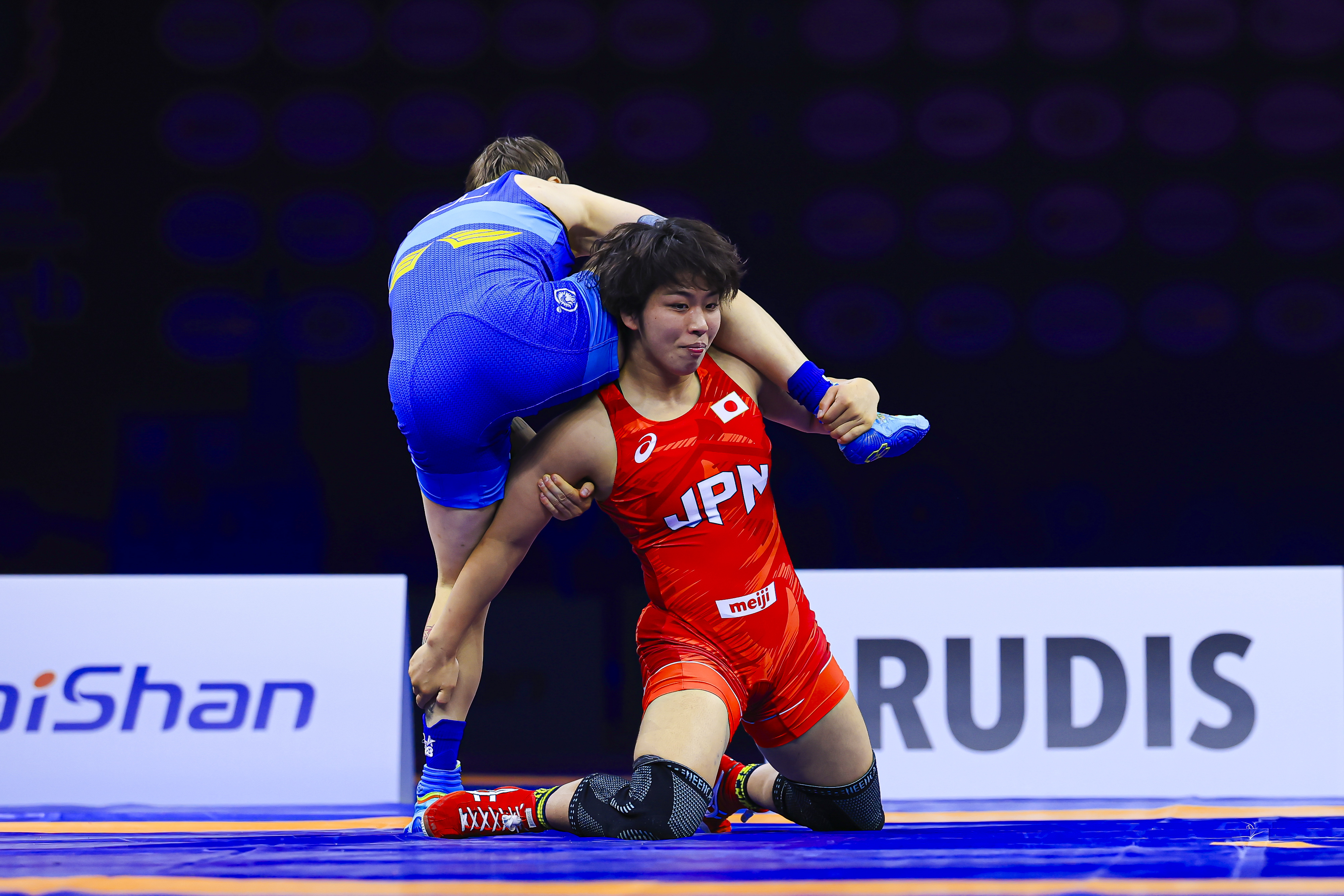 Ami ISHII (JPN) tries to score on Yuliana YANEVA (BUL) in the 68kg final. (Photo: United World Wrestling / Kadir Caliskan)
At 68kg, Ishii had plowed through the field to make the final, where she met stiff resistance from four-time European medalist Yuliana YANEVA (BUL) and needed a second-period takedown to secure a 4-2 victory.
It was Yaneva who struck first when she adroitly used a counter lift for a two-point lead. Ishii came back with a stepout, but an apparent takedown was wiped out on challenge as having been completed after the buzzer.
Down by a point, Ishii warily avoided the counter and went with an arm drag to get behind for a takedown to go ahead 3-2. A short time later, Yaneva shot in for a single, but Ishii slipped under and grabbed Yaneva's leg, then clung on to force a stalemate. An unsuccessful challenge at the end gave Ishii her final point.
"I thought I might get countered again," Ishii said of her strategy for the second period. "Still, I had to get points. It would be the end if I lost my nerve. Even if I couldn't get in [on a tackle], I had to find a way to get points."
Ishii has been a workhorse since missing out on the Paris Olympics when she suffered a heartbreaking, last-second loss for the 68kg spot to Ozaki. She won the 72kg gold at last year's Non-Olympic World Championships as a sort of consolation, so winning at 68kg holds more significance.
"Without a doubt, it's getting to a place closer to the Olympics," Ishii said, adding that her mission now will be staying at the top of the division in Japan. "It's tough to be at this level, and I can't just keep going as I am now. I need to raise my level, so I have to train even harder."
In the last match of the night, two-time European champion Belinska, who had received an activity point in the first period, came out in the second and caught Bas in a headlock before securing the fall in 4:25.
"The final was tense, but I had prepared my throw, and I’m very happy that I managed to execute it," Belinska said. "In the first period, I couldn’t make that move, and the tension started to build -- but even in a stressful situation, I was still able to pull it off."
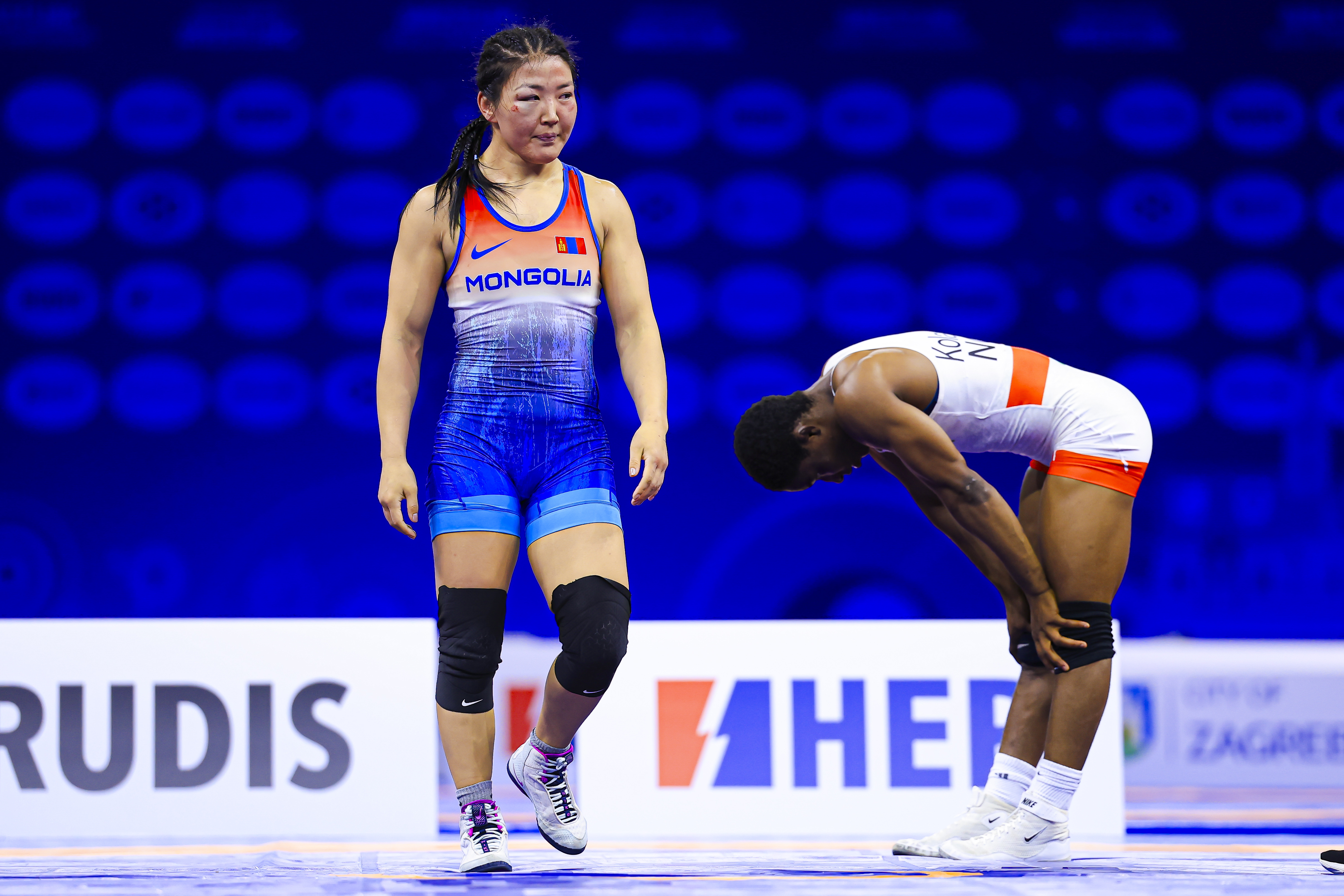 Orkhon PUREVDORJ (MGL) defeated Esther KOLAWOLE (NGR) to win bronze at 62kg. (Photo: United World Wrestling / Kadir Caliskan)
Purevdorj captures bronze 8 years after striking gold
Eight years after winning a world gold, Orkhon PUREVDORJ (MGL) finally picked up her another medal, taking a 62kg bronze by rallying to a nail-biting 6-5 victory over Esther KOLAWOLE (NGR).
After Purevdorj received an activity point in the first period, she fell into a large hole by giving up a 4-point takedown at the edge to open the second period. Purevdorj picked up a 2-point exposure on a scramble, which, after a scramble, revealed a foul by Kolawole. That gave Purevdorj a point and, significantly, put her on top in par terre.
She took advantage by executing a gut wrench and, even though Kolawole reversed, it left the Mongolian with a 6-5 advantage that she maintained through the end.
Amina TANDELOVA (UWW) earned her first world medal when she scored a duck under takedown in the final minute to defeat Bilyana DUDOVA (BUL) 4-2 for the other 62kg bronze.
Asian champion Hyongyong CHOE (PRK) added the senior world bronze to her Olympic bronze from Paris with a victory at 53kg by second-period fall over Shokhida AKHMEDOVA (UZB) after building up an 8-0 lead.
Choe went for the kill at all times, scoring two exposures off a head lock, then ending the match when she scored a takedown and immediately applied a half-nelson to turn Akhmedova over.



 Participants pose for a photo after the conclusion of The South-East Asia & Oceania Education Week. (Photo: United World Wrestling)
Share your thoughts.
Comments