

Strengthening the Skills of Coaches, Referees, and Administrators for the Development of Wrestling in Africa
Friday, April 4, 2025 - 13:03 By United World Wrestling Press

El Jadida, UWW Africa Center – (April 4) --- United World Wrestling Africa, under the leadership of its President, Fouad Meskout, Vice President of United World Wrestling, is firmly committed to the development of wrestling on the continent. In collaboration with the Royal Moroccan Wrestling Federation, a certification training was organized from March 23-29, 2025.
As a prelude to the 2025 African Championships, which will be held in Morocco in early May 2025, the UWW Africa Center in El Jadida hosted an extensive training program designed for coaches, referees, and administrators across Africa. This seven-day intensive program aimed to enhance the technical and administrative skills of key stakeholders in the development of wrestling on the continent.
A Pan-African Participation
Representatives from several African nations participated in this training session, demonstrating the growing commitment to developing wrestling across the continent. The participating countries included Angola, Burkina Faso, Côte d'Ivoire, Cameroon, Tunisia, South Africa, Guinea, and Morocco.
List of Participants:
- Angola: Nseke Tiago Ndonga
- Burkina Faso: Zinzere Wendpoulougo Augustae Daniel, Debe Blaise, Kabre Ousseni (President of the Federation)
- Côte d'Ivoire: Coulibaly Yire Mariam Solange, Assalé Adje Jean-Claude Pamphille
- Cameroon: Tsam Megom Gervais, Ngono Eyia Epse Ngoumou Edwige
- Tunisia: Aymen Lamloumi
- South Africa: Davel Donawan
- Morocco: Kabil Driss, Najih Abdelhak, Ouled Ben Taliaa Redouane, Hatimi Youssef
- Guinea: Sow Mamadou Bodo (Secretary General of the Federation)
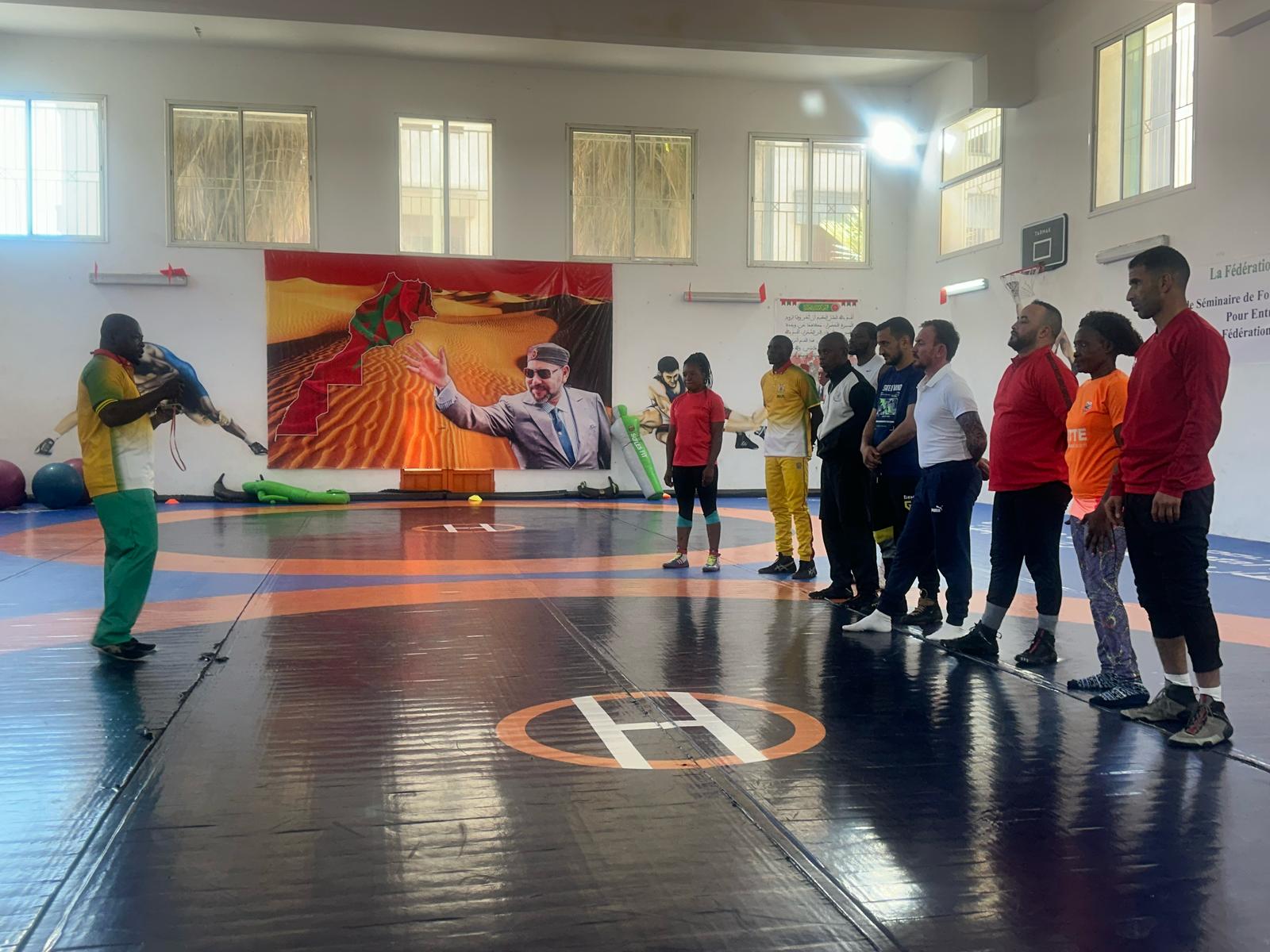 Participants walk through a training session with UWW Development Officier, Vincent AKA. (Photo: United World Wrestling)
A Well-Structured and Comprehensive Program
During this training, participants followed an intensive curriculum focused on the three key domains of wrestling development:
✔ Coaches: Technical and methodological skill development, training plan design, performance management, and athlete safety.
✔ Referees: Advanced rule analysis, positioning on the mat, competition management, and communication.
✔ Administrators: Official communication management, utilization of UWW digital tools (Athena Platform, UWW Academy, Development Programs).
Under the supervision of renowned experts, including Vincent AKA (Coach Trainer and UWW Development Officer), Kamel Bouaziz (Referee Trainer), and Youssef Bouaziz (Administrator Trainer), participants received high-level training, equipping them with new skills to effectively contribute to the growth of wrestling in their respective countries.
Testimonials from Participants
📌 Kabil Driss (Coach, Morocco):
"I am proud and very happy to have participated in this training. We have built an extraordinary friendship with my fellow referees, coaches, and administrators. Thank you for your competence and warm participation in this seminar in Morocco. A big thank you to Mr. AKA, an exceptional leader in the development of wrestling in Africa. Your training and collaboration, as well as your educational system, have allowed us to learn and improve our understanding of our respective roles."
📌 Donovan Davel (South Africa):
"First of all, I would like to thank the Moroccan Wrestling Federation for organizing this wonderful training week. I also want to express my gratitude to the entire center’s team for their kindness and warm welcome. To the trainers Mr. Vincent, Kamel, and Youssef, your teaching was exceptional. It was a great privilege to be part of this program. I am convinced that we will all share this experience and the valuable knowledge gained in our respective countries to continue developing our beloved sport."
📌 Assalé Adje Jean-Claude Pamphille (Côte d’Ivoire):
"We return to our homeland with a great impression and a mind full of valuable knowledge. I cannot continue without reiterating my gratitude to our three trainers: our compatriot Vincent Aka (Coach Training Module), Bouaziz Med Kamel (Referee Training Module), and Youssef Bouaziz from the IT department (Administrator Training Module). Their expertise was undeniable. We return home with the necessary skills to improve our federation’s operations, especially for the benefit of our athletes."

Participants learn about the extensive training program designed for coaches, referees, and administrators at the UWW Africa Center in El Jadida.
Closing and Future Prospects
The training concluded on March 29, 2025, with an assessment of the knowledge acquired and a certificate award ceremony hosted by members of the Royal Moroccan Wrestling Federation. This initiative aligns with United World Wrestling Africa’s mission to professionalize and structure wrestling across the continent.
Present at the closing ceremony, Kabre Ousseni, the newly elected President of the Burkinabé Wrestling Federation, expressed his gratitude:
"I would like to thank the members of the Royal Moroccan Wrestling Federation for their presence, which added prestige to this ceremony. I also take this opportunity to commend President Fouad Meskout for his continuous efforts in developing wrestling on the continent."
With these newly acquired skills, the trained coaches, referees, and administrators are now better equipped to train and develop wrestling in their respective countries, contributing to the growth of this sport across Africa.
President Fouad Meskout emphasized:
"We are on the right track to overcome challenges together, and we will continue to organize development activities ahead of the African Championships."

 Sarah HILDEBRANDT (USA) is the Olympic champion at 50kg. (Photo: United World Wrestling / Kadir Caliskan)
 Zaineb SGHAIER (TUN) is a two-time Olympian from Tunisia. (Photo: United World Wrestling /Amirreza Aliasgari)
 Paris Olympic silver medalist at 57kg Anastasia NICHITA (MDA). (Photo: United World Wrestling / Kadir Caliskan)
Share your thoughts.
Comments