CASABLANCA, Morocco (May 4) -- Nigeria entered nine wrestlers in Women's Wrestling at the 2025 African Championships and all nine are going back home with gold medals.
The country emerged as the top nation in Women's Wrestling and by some distance. It had had 225 points, 109 points more than second-placed Algeria which won one gold -- at 57kg, a weight class that did not feature a Nigerian wrestler. Egypt finished third with 115 points. Hosts Morocco finished a close fourth with 113 points.
After Nigeria won four gold medals on Saturday through Christianah OGUNSANYA (NGR) at 53kg, Esther KOLAWOLE (NGR) at 62kg, Hannah RUEBEN (NGR) at 68kg and Damola OJO (NGR) at 76kg, it added five more on Sunday.
Mercy GENESIS (NGR) defended her 50kg gold medal with a clean 11-0 win over Cheima CHEBILA (ALG) in the final. That was her fourth victory via technical superiority.
Soon after, defending champion Adijat IDRIS (NGR) dominated Achouak TEKOUK (ALG) in the 55kg final, winning the gold 11-1, her fifth technical superiority win similar to Genesis.
Jumoke ADEKOYE (NGR), who won gold medal at 55kg in 2022 and 2023, returned after two years and showed no signs of rust due to the break. She also won five bouts, three via fall and two via superiority. In the final, she defeated Rahma BEDIWY (EGY) via fall after building a 10-0 win.
Ebipatei MUGHENBOFA (NGR) too defended her 65kg gold medal but needed some effort as Cara DU PLESSIS (RSA) posed a threat in the final. But Mughenbofa secured a fall over Du Plessis, denying the South African a historic gold.
South Africa was searching for its first Women's Wrestling gold at the African Championships since 2000 and Du Plessis fell short. However, she became the first South African wrestler to reach the final since 2015.
In a round-robin bracket, Ebi BIOGOS (NGR) clinched the 72kg gold medal to maintain a perfect record for Nigeria which had nine wrestlers participating in the tournament and all nine won gold medals.
 Omar MOURAD (EGY) won the 74kg gold medal at the African Championships. (Photo: United World Wrestling / Amirreza Aliasgari)
Egypt maintain Freestyle dominance
After clinching the Greco-Roman team title, Egypt won the Freestyle team title as well. It scored 182 points to finish at the top followed by Morocco with 110 points and Algeria was third with 105 points.
Egypt won four gold medals, two silvers and two bronzes. Two wrestlers did not win any medals but added 12 points to the total to help the country to the title.
The young pair of Omar MOURAD (EGY) and Aabdelrahman SHEYATAN (EGY) won gold medals at 74kg and 97kg respectively. Hassan ELSAYED (EGY) upgraded his bronze to gold at 61kg while Ahmed MAHMOUD (EGY) returned to the African Championships after two years to win the 86kg gold medal.
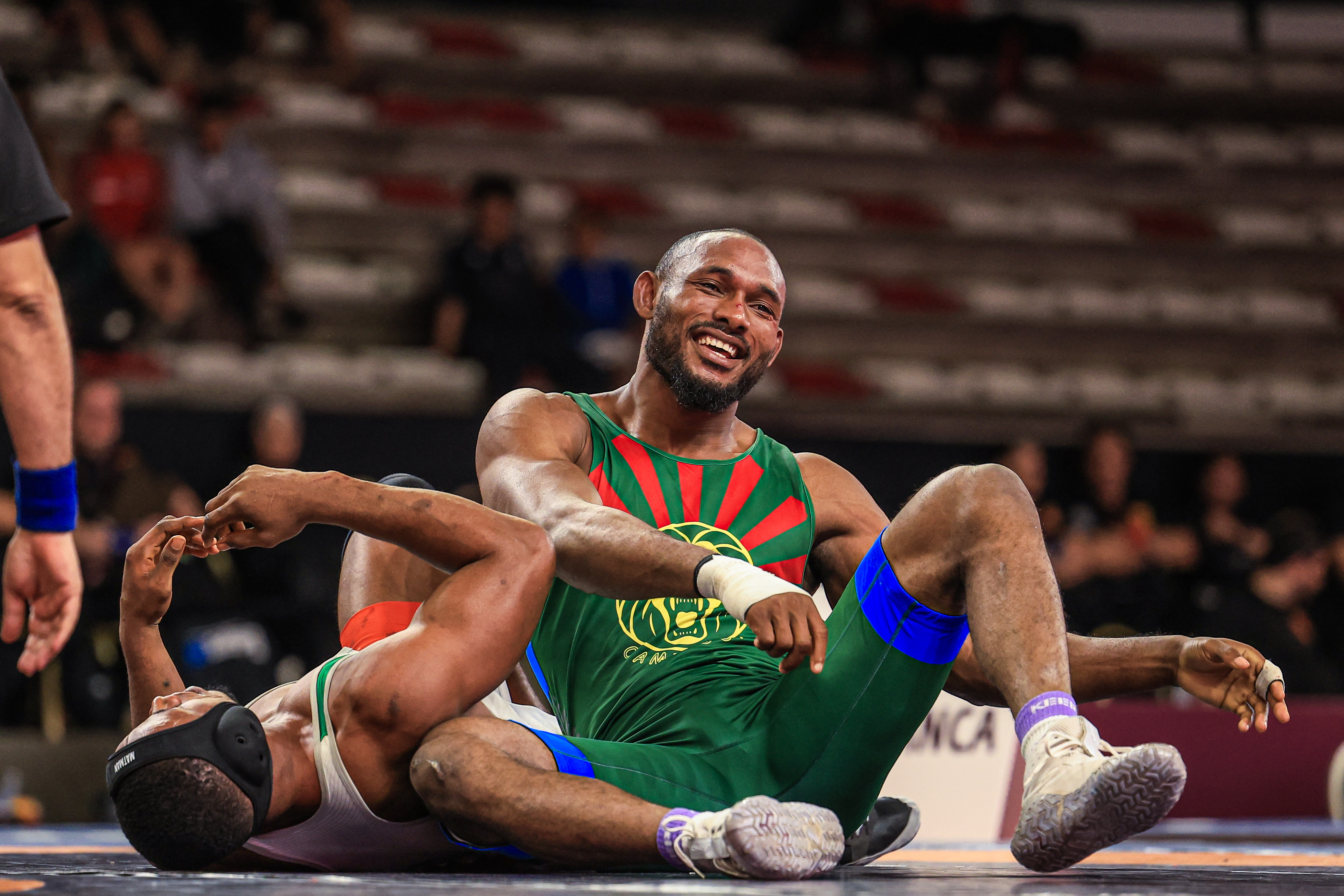 Cedric ABOSSOLO (CMR) celebrates after winning the 92kg gold medal. (Photo: United World Wrestling / Amirreza Aliasgari)
But the story of the tournament was Cedric ABOSSOLO (CMR), who won the 92kg gold medal after a stunning performance with four wins, all without giving up a point. The gold medal was Cameroon's first in Freestyle at the African Championships since 1998.
Abossolo, who had not won a medal at the African Championships in his past three attempts, defeated Ebikeme NEWLIFE (NGR) via fall in the final after building a 9-0 lead.
The 25-year-old Abossolo scored takedown and turn while Newlife was on activity clock to lead 5-0. He hit an arm throw for four points and then held Newlife on the mat for a fall with 2 minutes remaining on the clock.
In other weight classes, Oussama ASSAD (MAR) gave hosts Morocco the lone gold medal in Freestyle at 125kg. His win ended Egypt's 11-year golden streak at the African Championships as the last time a non-Egyptian wrestler won gold at 125kg was in 2014 when Slim TRABELSI (TUN) won gold.
Paris Olympian Diamantino IUNA FAFE (GBS) completed a hat-trick of gold medals at 57kg after he sneaked through a thrilling 10-8 win over Salah KATEB (ALG) in the final.
Kateb opened the scoring with a arm-throw for four points but Iuna Fafe recovered to block Kateb for a pin which he survived and scored a reversal for a 5-2 lead. A point was awarded to Kateb as Iuna Fafe headbutted, a reaction to open hand hitting from Kateb. A second into the restart, Kateb was docked a point for open hands.
Iuna Fafe got going soon after and scored two step outs to reduce Kateb's lead to 6-5 with 1:25 remaining on the clock. But Kateb made it 10-5 as he countered a forward pressure from Iuna Fafe with a underhook sidethrow for four points.
Iuna Fafe challenged the four-point call and on review it was scored only two points as his knees were still on the mat when he got thrown. He had 31 seconds to recover from 8-5 to win the final.
A moment of brilliance from Iuna Fafe with 20 seconds on the clock saw him score a takedown and then a turn using figure 4 to win 10-8. He broke out into a dance celebration making his hands as tiger claws, symbolizing a hunt on the mat.
Algeria did win a gold medal through Abdelkader IKKAL (ALG) who blanked Mohammed BOUAZOUNI (MAR), 10-0, in the 79kg final.
At 65kg, Stephen IZOLO (NGR) defeated Farouk JELASSI (TUN), 5-1, to give Nigeria a gold medal, the country's first in Freestyle at African Championships in five years.
The 70kg gold medal went to Tunisia after Khairiddine BEN TLILI (TUN) defeated Mohamed AHMED (EGY), 10-0, in the final, his third technical superiority win in three bouts.

RESULTS
Women's Wrestling
50kg
GOLD: Mercy GENESIS (NGR) df. Cheima CHEBILA (ALG), 11-0
BRONZE: Malak AHMED (EGY) df. Chloe BREWIS (RSA), via inj. def.
55kg
GOLD: Adijat IDRIS (NGR) df. Achouak TEKOUK (ALG), 11-1
BRONZE: Lobna ICHAOUI (TUN) df. Sara ETTAKI (MAR), 3-1
59kg
GOLD: Jumoke ADEKOYE (NGR) df. Rahma BEDIWY (EGY), via fall (10-0)
BRONZE: Chahd JELJELI (TUN) df. Rayane HOUFAF (ALG), via fall (10-0)
65kg
GOLD: Ebipatei MUGHENBOFA (NGR) df. Cara DU PLESSIS (RSA), via fall (8-2)
BRONZE: Mouda HAMDOUN (EGY) df. Kawiyatou ISSIFOU (BEN), 12-2
BRONZE: Lec ANDE (CAF) df. Vihanshy KANAPETRADU (MRI), 8-2
72kg
GOLD: Ebi BIOGOS (NGR)
SILVER: Yasmine BOUREGBA (ALG)
BRONZE: Rosie TABORA (COD)
Freestyle
57kg
GOLD: Diamantino IUNA FAFE (GBS) df. Salah KATEB (ALG), 10-8
BRONZE: Roland TAMBI NFORSONG (CMR) df. Lenerd VAN SCHALKWYK (RSA), 7-2
BRONZE: Omar FAYE (SEN) df. Ben TARIK (MAR), 10-7
61kg
GOLD: Hassan ELSAYED (EGY) df. Didier DIATTA (SEN), 8-6
BRONZE: Radouane SISSAOUI (ALG) df. Rabby KILANDI (COD), 9-8
BRONZE: Khalil BARKOUTI (TUN) df. Ndjidda BOUBA (CMR), via fall (10-0)
65kg
GOLD: Stephen IZOLO (NGR) df. Farouk JELASSI (TUN), 5-1
BRONZE: Wotna NDOC (GBS) df. Godefroid KALUBI (COD), 13-1
BRONZE: Said ELGAHSH (EGY) df. Rida DJEFFAL (ALG), 15-4
70kg
GOLD: Khairiddine BEN TLILI (TUN) df. Mohamed AHMED (EGY), 10-0
BRONZE: Gabriel MUANDA (COD) df. Anthony WESLEY (CPV), via fall (13-4)
BRONZE: Tope ADEBAYO (NGR) df. Otmane EL BAHJA (MAR), 6-1
74kg
GOLD: Omar MOURAD (EGY) df. Saad BOUGUERRA (ALG), 10-0
BRONZE: Ebierelayefa ANDREW (NGR) df. Jesse VAN BAALEN (RSA), 11-0
BRONZE: Caetano ANTONIO SA (GBS) df. Joao BARBOSA (CPV), 10-4
79kg
GOLD: Abdelkader IKKAL (ALG) df. Mohammed BOUAZOUNI (MAR), 10-0
BRONZE: Mbaye DIOP (SEN) df. Mathayo MAHABILA (KEN), 5-2
BRONZE: Andy MUKENDI (COD) df. Alfred DANIEL (SLE), 10-0
86kg
GOLD: Ahmed MAHMOUD (EGY) df. Siny SEMBENE (SEN), via fall (2-1)
BRONZE: Matteo MONTEIRO (CPV) df. Iliassou BONI (BEN), 12-1
BRONZE: Houssem OUCIF (ALG) df. Walid CHEIKH LAHLOU (MAR), 10-0
92kg
GOLD: Cedric ABOSSOLO (CMR) df. Ebikeme NEWLIFE (NGR), via fall (9-0)
BRONZE: Mohamed AHMED (EGY) df. Mamadou DIOUF (SEN), 8-4
97kg
GOLD: Aabdelrahman SHEYATAN (EGY) df. Gino INTCHALA (GBS), 14-3
BRONZE: Barthelemy TSHOSHA (COD) df. Ayoub NASSR ELLAH (MAR), 11-1
125kg
GOLD: Oussama ASSAD (MAR)
SILVER: Youssef ABOUDAWABA (EGY)
BRONZE: Issah FUSEINI (GHA)




Share your thoughts.
Comments