

UWW development reaches beyond borders in landmark year
Thursday, December 22, 2022 - 08:29 By United World Wrestling Press

CORSIER-SUR-VEVEY, Switzerland (December 22) -- A programme that provides more opportunities for women to progress into leadership roles, courses designed to educate coaches and referees, opening the doors to world-class training facilities to wrestlers from across the globe by partnering with INSEP keeping in mind the Paris Olympics, a multitude of anti-doping initiatives and restarting the refugee camp projects.
As 2022 draws to a close, the United World Wrestling looks back at a series of initiatives undertaken all through the years with an aim to consolidate the present and leap into a better tomorrow. These programmes ranged from humanitarian to technical, governance to education.
One of the highlights of the year is the re-starting of the refugee camp project in Jordan. As a part of the International Olympic Committee’s Refugee Athletes’ promotion since the Rio 2016 Olympics, UWW President Nenad LALOVIC decided to promote wrestling in United Nations refugee camps across the world. The Refugee Camp in Jordan is in continuation of this programme.
 More Than Medals camp in Rome. (Photo: United World Wrestling)
The UWW closely collaborated with all the organisations involved in the development of sport, especially the Olympic Solidarity and the IOC. The UWW delivered technical courses in 19 countries and financially supported national competitions attached to the course. Technical support was also provided to host the continental as well as the senior world championships this year along with training camps for the U17 wrestlers.
Another successful programme of the UWW Development Department was holding the Regional Educational Development Tournament (REDT). The regional course and tournament centred on training and educating the coaches and referees were held in Mauritius – marking the first time the REDT was held in the Indian Ocean – followed by Vietnam and Cambodia. This program has contributed to upgrading the teaching skills of coaches and referees.
 Participants during coaching course in Budapest. (Photo: United World Wrestling / Martin Gabor)
With the support of Olympic Solidarity, the first-ever high-performance regional coaching course was also held in Budapest, Hungary. The participation of 32 coaches from seven countries in this course was a major milestone, more so as it was held at one of the powerhouses of world wrestling. A Technical Course for Coaches Level 1 combined with the Introduction to Refereeing course will also be held in Palestine in December.
The UWW also donated mats and training equipment to Costa Rica, the Dominican Republic, Colombia, Albania, Australia, Jordan and the Democratic People’s Republic of Korea.
Laying emphasis on education to prevent doping, the UWW held anti-doping education drives during the Senior World Championships as well as in collaboration with National Federations. The wrestlers were also educated about the consequences of doping, the testing protocols, the risks associated with nutritional supplements and therapeutic use exemptions.
Safeguarding the athletes and ensuring safe sport has been set as one of the key areas the UWW will invest in starting this Olympic cycle in order to have a healthy sporting environment for the athletes.
Keeping athletes at the heart, the UWW also continued to jointly collaborate with the Olympic Council of Asia and the Panam Sports which contributed to reinforcing the organisation’s professionalism and sharing the experience.
 Women Referee course held in Istanbul, Turkey. (Photo: United World Wrestling)
This was also an important year in the steps taken in educating the coaches and referees.
Nearly 50 UWW Coach/Referee educators were certified through two courses that were held in Guatemala and Turkey. In addition to Olympic Solidarity courses, the educators held nine National Coach Courses and Introduction to Referee Courses, which were funded by National Federations or partially funded by the UWW.
The first-ever High-Performance Regional Course in Budapest, Hungary, was another landmark moment apart from the three new online courses that were introduced: Rules Modifications for 2022, Evaluation of Takedown and Control, Understanding and Developing the Whole Wrestler.
Other than these, additional coaching programmes were also created which allowed the UWW to have five different levels to the modules:
Level 1 – Introduction to Coaching and Safety
Level 2 – Introduction to Practice Planning
Level 3 – Periodization and Coaching Philosophy
Level 4 – Athlete and Programme Development
Level 5 – High-Performance Course
 Coahes who are selected for the WISH Program. (Photo: United World Wrestling)
For promoting the participation of women in the sport, the UWW supported six women coaches in the Women in Sport High-Performance (WISH) programme. Six current and/or future coaches were selected for the 21-month programme, which has been developed in coordination with a team of specialists at the UK-based University of Hertfordshire. The programme aims to help women coaches, who have the potential and ambition, to progress into high-performance coaching roles at national and international levels. This is the largest number of participants the UWW has supported in this programme.
Under the Referee Scholarship Programme, the UWW sponsored more referees than ever before. Fourteen referees were provided both the flight and accommodation for a promotion event while there were seven additional referees who were provided accommodations at the event. This is a record participation number for this programme.
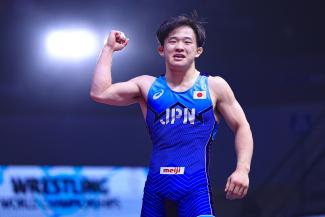

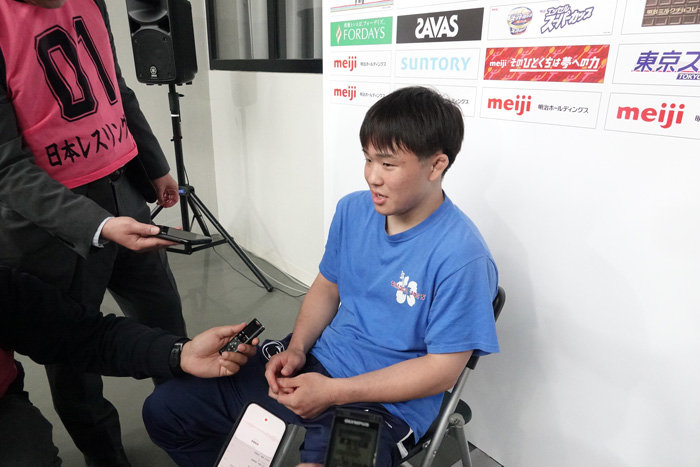 Masanosuke ONO (JPN) giving interview on the sidelines of the Meiji Cup. (Photo: wrestling-spirits.jp / Ikuo Higuchi)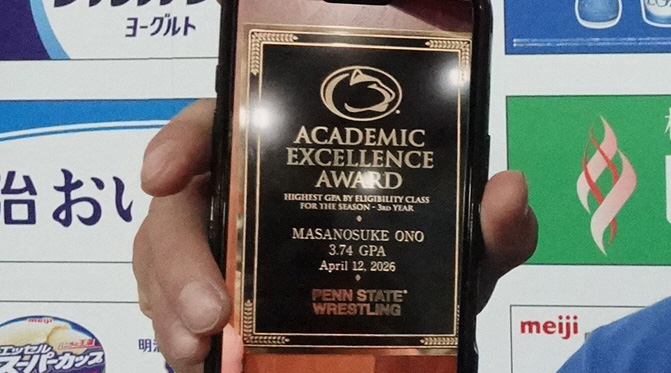
Share your thoughts.
Comments