RIYADH, Saudi Arabia (November 21) -- World champion Amir Hossein ZARE (IRI) led an inspiring performance from Iran which captured three out of four gold medal on the final day of the Islamic Solidarity Games 2025 in Riyadh on Friday.
Zare, who won gold medal at 125kg in Zagreb in September, dominated his way to the gold in Riyadh outscoring his opponents 28-0 in three bouts.
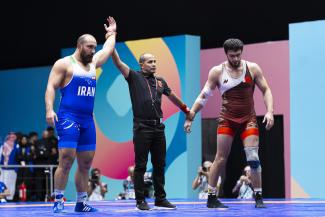
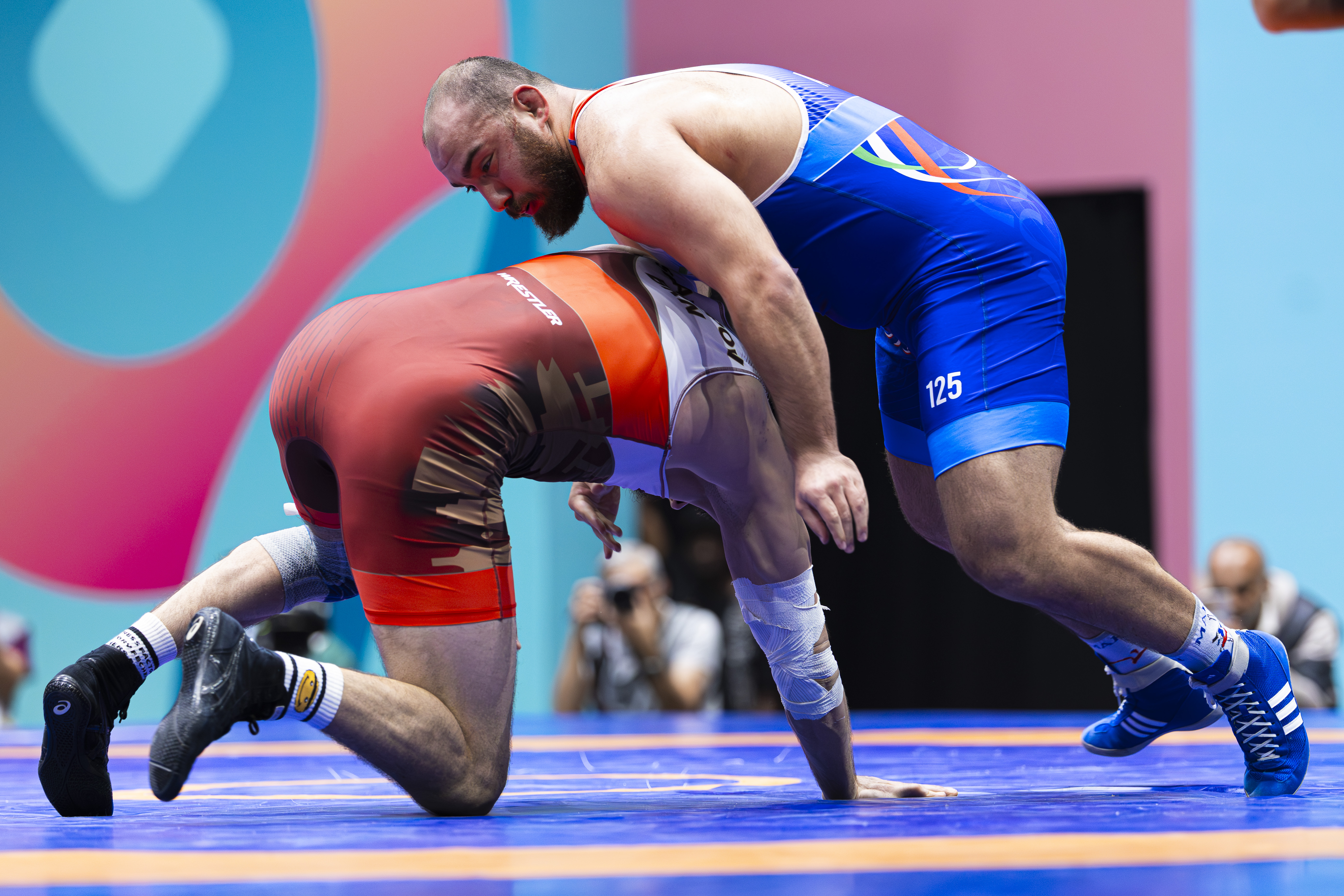 Amir Hossein ZARE (IRI) scores a takedown on Shamil SHARIPOV (BRN) during the 125kg final. (Photo: United World Wrestling / Kadir Caliskan)
Facing Shamil SHARIPOV (BRN) in the final, Zare combined his skills to score stepouts at win and also scored two takedowns to finish the match 10-0, capturing his fourth gold medal of the season.
Sharipov reached the final after securing a shocking win over world silver medalist Giorgi MESHVILDISHVILI (AZE) 7-6 in the semifinal. Meshvildishvili had to mount a comeback in the second period after he was down 5-1 in the match. He managed to make it 6-6 but trailed on criteria and as he tried to score a stepout in the final 10 seconds, Sharipov managed to remain inside the zone to survive attack.
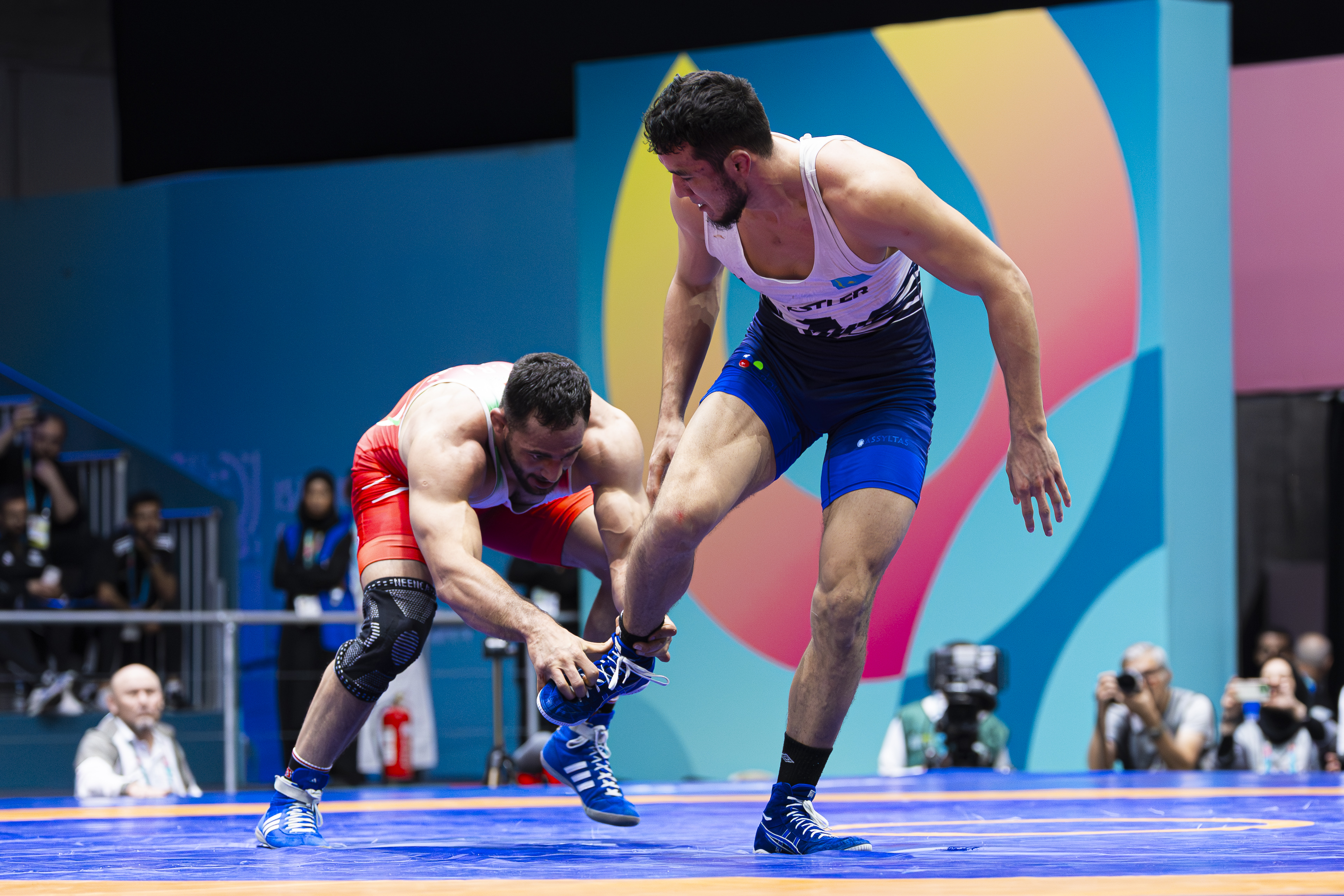 Amirali AZARPIRA (IRI) tries to control Rizabek AITMUKHAN (KAZ) during the 97kg final. (Photo: United World Wrestling / Kadir Caliskan)
At 97kg, a rematch between Olympic champion Akhmed TAZHUDINOV (BRN) and world silver medalist Amirali AZARPIRA (IRI) was on the cards but Rizabek AITMUKHAN (KAZ) denied that as he defeated Tazhudinov 14-3 in the semifinals.
Azarpira and Aitmukhan faced each other in the final but the former was clearly the better wrestler as he blanked Aitmukhan 5-0 to win the gold medal. He scored three stepouts and Aitmukhan was cautioned when aggressively pushed Azarpira. One more stepout was enough for Azarpira to win the gold medal.
Tazhudinov declared himself injured in the bronze medal bout which gave Olympic bronze medalist Magomedkhan MAGOMEDOV (AZE) the medal.
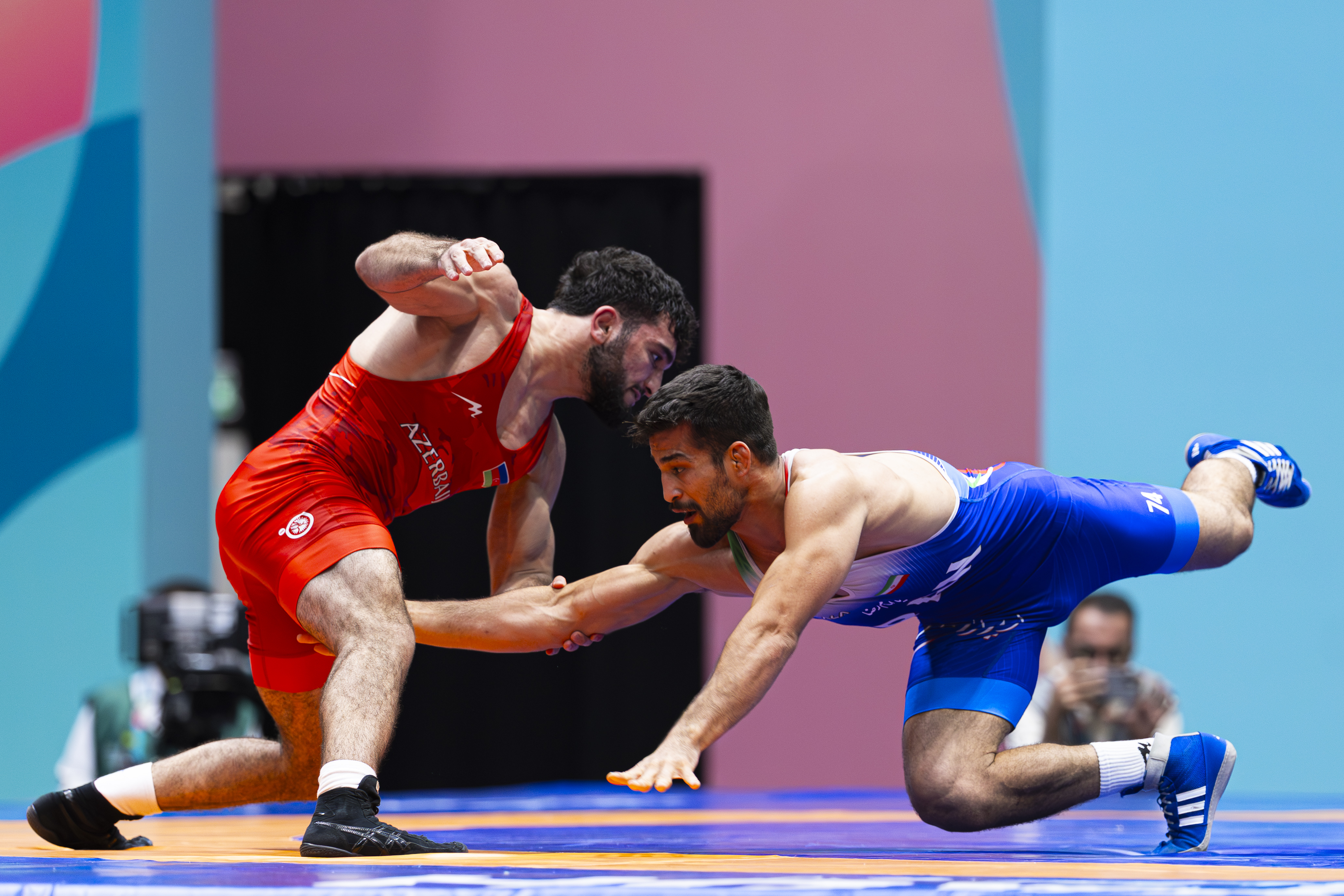 Younes EMAMI (IRI) reaches for the leg of Aghanazar NOVRUZOV (AZE) during the 74kg final. (Photo: United World Wrestling / Kadir Caliskan)
Iran's gold rush began when former Asian champion Younes EMAMI (IRI) completed a 5-0 victory over Aghanazar NOVRUZOV (AZE) at 74kg. Emami scored a takedown to take a 2-0 lead against Novruzov before pushing the Azerbaijan wrestler out of bounds twice before the break.
With a lead of 4-0, Emami began the second period on the aggressive and Novruzov was called passive. He failed to score in the 30-second period and Emami got another point to lead 5-0 which remained the winning score.
To reach the final, Emami had to go through 2024 world 70kg champion Norkozha KAIPANOV (KAZ) in the quarterfinals. The Iranian defeated the Kazakhstan wrestler 6-5 in a thriller.
With the three golds, Iran finished the tournament with four gold medal while Azerbaijan and Kyrgyzstan won one each.
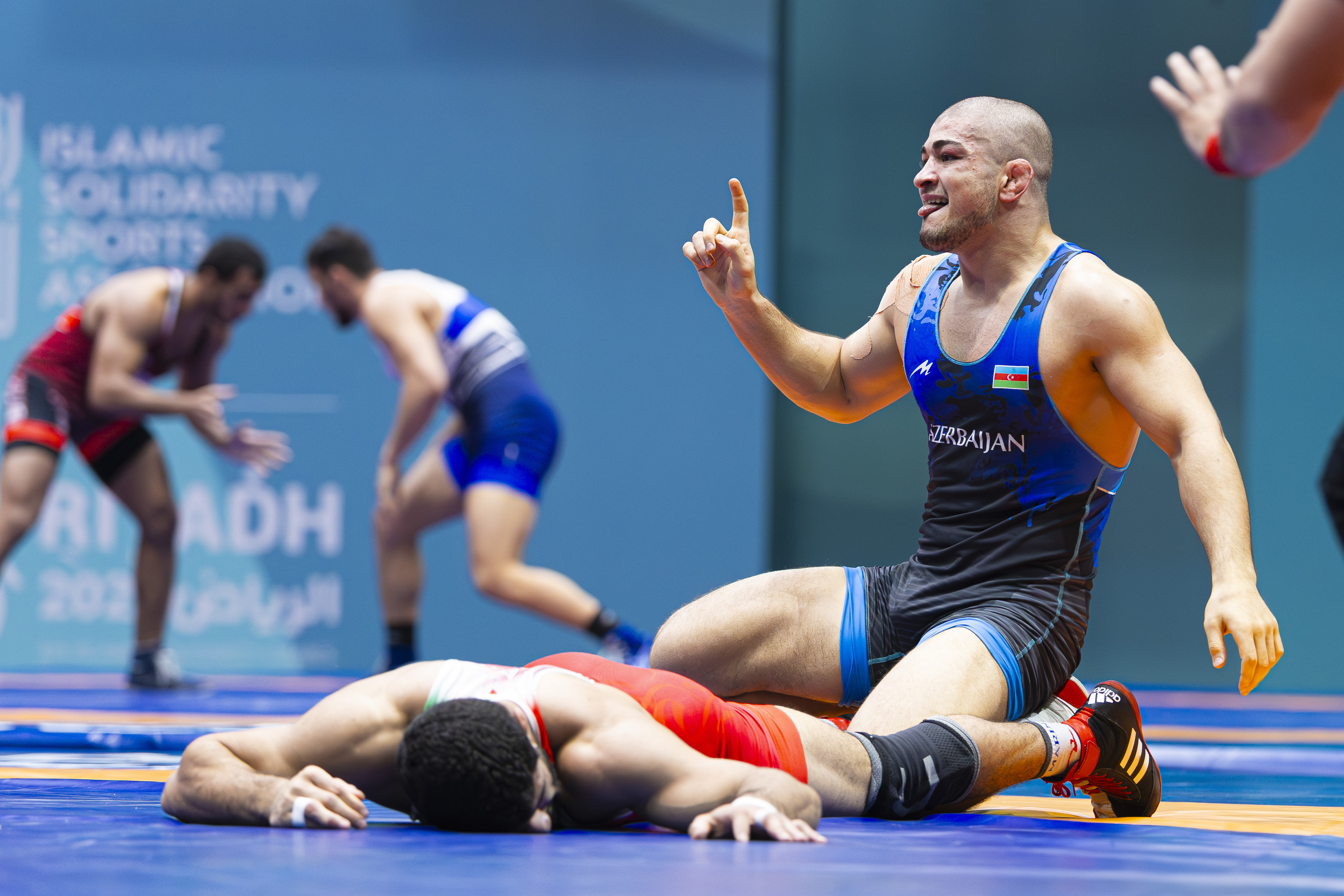 Arsenii DZHIOEV (AZE) celebrates after beating Kamran GHASEMPOUR (IRI) in their opening bout at 86kg. (Photo: United World Wrestling / Kadir Caliskan)
Dzhioev's impressive gold
One of Iran's favorite to win gold medal, Kamran GHASEMPOUR (IRI), suffered a heartbreaking loss at 86kg to Arsenii DIZHOEV (AZE) who capped off an incredible day with gold after beating Khidir SAIPUDINOV (BRN) 5-1 in the final.
The win over Ghasempour was quite impressive from Dzhioev. Down 3-0, he scored two takedowns and one point for Ghasempour's passivity to win the bout 5-3.
In the final against Saipudinov, he opened scored a takedown in the opening period after being called passive and giving up a point. He scored two stepouts and one point for passivity in the second period to win the final.
Ghasempour returned to win the bronze medal by beating Magomet EVLOEV (TJK), 7-0, in the bronze-medal bout.
RESULTS
74kg
GOLD: Younes EMAMI (IRI) df. Aghanazar NOVRUZOV (AZE), 5-0
BRONZE: Orozbek TOKTOMAMBETOV (KGZ) df. Nurkozha KAIPANOV (KAZ), 4-2
BRONZE: Magomedrasul ASLUEV (BRN) df. Fazli ERYILMAZ (TUR), 4-3
86kg
GOLD: Arsenii DZHIOEV (AZE) df. Khidir SAIPUDINOV (BRN), 5-1
BRONZE: Kamran GHASEMPOUR (IRI) df. Magomet EVLOEV (TJK), 7-0
BRONZE: Osman GOCEN (TUR) df. Bekzat RAKHIMOV (KGZ), 10-2
97kg
GOLD: Amirali AZARPIRA (IRI) df. Rizabek AITMUKHAN (KAZ), 5-0
BRONZE: Magomedkhan MAGOMEDOV (AZE) df. Akhmed TAZHUDINOV (BRN), via inj. def.
BRONZE: Muhammad GULZAR (PAK) df. Rifat GIDAK (TUR), via fall (4-5)
125kg
GOLD: Amir Hossein ZARE (IRI) df. Shamil SHARIPOV (BRN), 10-0
BRONZE: Hakan BUYUKCINGIL (TUR) df. Arslanbek TURDUBEKOV (KGZ), 14-3
BRONZE: Giorgi MESHVILDISHVILI (AZE) df. Abdelrahman SHEYATAN (EGY), 5-0



Share your thoughts.
Comments