#development

ASDEC Chair Niamkey Leads Workshop on Sports Development

By United World Wrestling Press

LAUSANNE, Switzerland (May 9) -- Collaboration, innovation and open exchange was at the heart of a two-day workshop, organised by the ASOIF Sport Development and Education Commission (ASDEC) on May 5 and 6 in Lausanne, Switzerland. The meeting brought together more than 60 participants from 30 International Federations (IFs) for two days of peer exchange and practical discussion on key issues shaping the future of sport development.

Held in a collaborative and informal setting, the workshop focused on topics including coach development, officiating, National Federation support, and the evolving delivery of sport development programme.

During the workshop, Olympic Solidarity hosted roundtable discussions giving participants an opportunity to exchange feedback, ideas and perspectives on existing programmes and future collaboration opportunities.

Participant feedback strongly highlighted the value of the workshop as a trusted environment for open discussion, practical learning and networking across International Federations. Many participants - particularly first-time attendees, but also experienced delegates who had attended numerous workshops - emphasised the importance of having a collaborative and non-political space in which to share challenges, ideas and experiences openly.

ASDEC Chair Deqa NIAMKEY, Development Director at United World Wrestling, highlighted after the workshop:

"The ASDEC Workshop 2026 was a great success, offering International Federations a wide range of relevant topics, including updates on the current trends and landscape of sports business industry, participation programmes, and strategies for entering new markets," Niamkey said.

"The workshop also fostered meaningful discussions with key partners focused on the development and growth of our sports. It continues to serve as an important platform for networking, exchanging ideas, sharing best practices, and transferring knowledge, all in line with ASOIF’s broader good governance strategy."

The workshop concept is fully aligned with the third strategic pillar of the ASOIF Strategy 2026–2032, which focuses, among other priorities, on developing and modernising platforms for shared learning and adding value by addressing member priorities and sector developments.

Read More: From AI to Officiating, ASOIF Workshop Explores Future of Sport Development
#development

South Africa Advances National Wrestling System with DNSS Phase 2

By United World Wrestling Press

PRETORIA, South Africa (April 8) -- South Africa has reached a decisive milestone in its long-term wrestling development strategy with the successful implementation of Phase 2 of the Development of National Sport System (DNSS) programme, delivered in collaboration with United World Wrestling (UWW) and supported by Olympic Solidarity.

Following the diagnostic and mapping phase conducted earlier, Phase 2 marks a clear transition from analysis to structured implementation, laying the foundation for a sustainable and internationally aligned wrestling system.

Led by UWW Development Officer Vincent AKA, in close cooperation with the South African Wrestling Federation (SAWF), the National Head Coach, Markus DEKKER and Provincial Coordinators, the programme was deployed across multiple provinces through a structured 10-day intervention from March 2 to 13. 

Activities were conducted in key locations including:

· LPWA (Ion Bachu)
· CGWA (Ruiter)
· NGWA (Menlo Park Hall)
· Frank Joubert Tournament (Menlo Park Hall)

This nationwide approach ensured direct engagement with provincial structures, strengthening alignment between national leadership and local associations while promoting inclusive development across the country.

From Talent Identification to System Building

Unlike traditional training camps, DNSS Phase 2 focused on identifying talent and building long-term development systems. Wrestlers and coaches from all age categories -- U13, U15, U17, U20, and Senior -- were actively involved, ensuring a complete pathway approach.

Provincial visits and stakeholder meetings played a key role in assessing facilities and operational structures, strengthening coordination between SAWF and provinces, and identifying emerging wrestlers.

Building Athlete Pipeline

A training camp for different provinces brought together wrestler to consolidate talent identified during Phase 1 and introduce standardized training methodologies.

The training camp included technical sessions, physical conditioning, match simulations and wrestling. The initiative contributed to the creation of an updated national prospect and the foundation of a structured athlete monitoring system.

South Africa

Beach Wrestling Gains Momentum

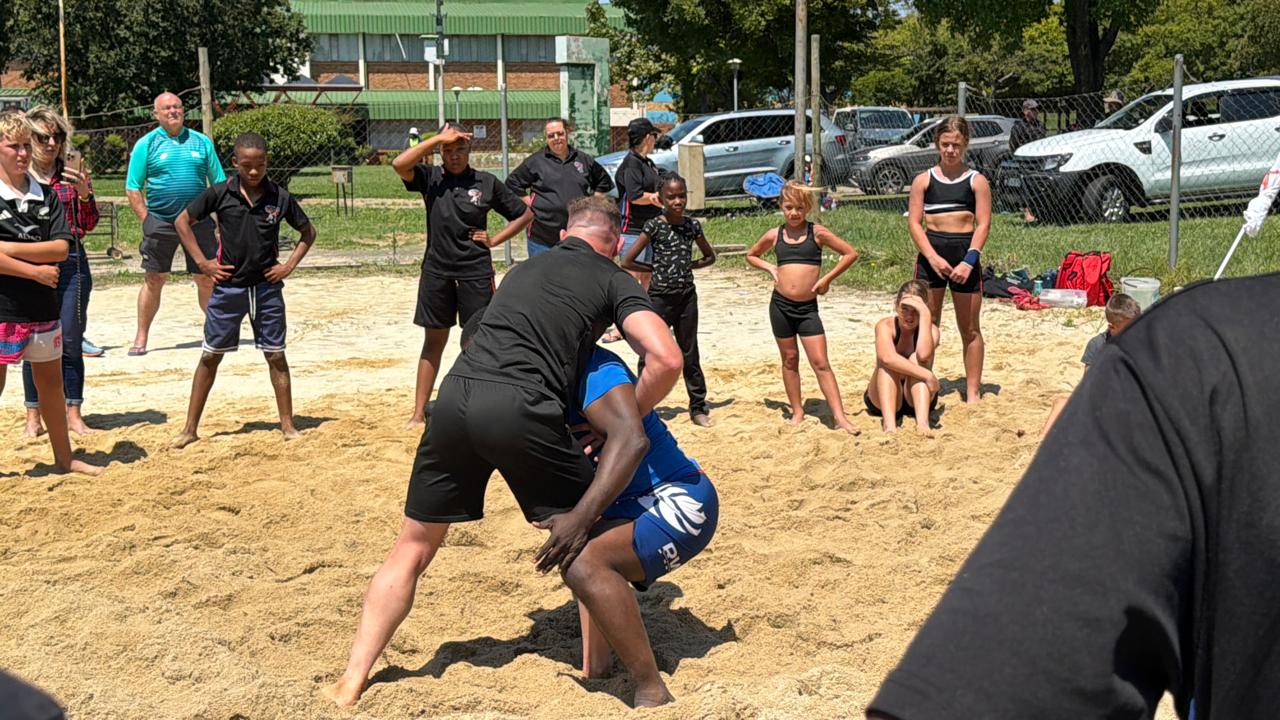
As part of the DNSS activities, a Beach Wrestling training session in Roodepoort highlighted the programme’s expanding impact.

During the visit, Aka led a specialized session, sharing advanced technical insights adapted to beach wrestling. It included stance and balance adjustments, grip and control techniques, and movement adaptation on sand.

The training programme comes at a crucial time, as South African athletes prepare for African Beach Wrestling Championships in Alexandria, Egypt and other international tournaments.