

Development

Wrestling's Niamkey Named Chair of ASOIF Sports Development and Education Group

By United World Wrestling Press

Experts from 28 International Federations (IFs) governing summer and winter Olympic sports and representatives from the International Olympic Committee (IOC) gathered this week at the seventh edition of ASOIF’s Sports Development and Education Forum (ASDEG Forum). The event was held on 28 and 29 May 2019 at the International Basketball Federation (FIBA) headquarters in Mies, Switzerland, led by the ASOIF’s ASDEG Consultative Group.

The group shared best practices of their e-learning programmes for education of anti-doping, pathway to international competitions and athlete’s safeguarding and welfare. The International Judo Federation and International Tennis Federation provided updates of their online academies which offered extensive online resources to educate and support their athletes and coaches. The IFs also exchanged thoughts of how to help their National Federations (NFs) grow into their sports. The FIBA presented its dedicated project to transfer knowledge and optimise investment to the NFs.

With the Tokyo 2020 Olympic Games on the horizon, the International Hockey Federation shared its approach to ensure a legacy for next year’s Games. The group explored a collective action plan to be implemented in this regard with close cooperation between the IOC, ASOIF and IFs. In view of the Youth Olympic Games 2022 to be held in Dakar, Senegal, a representative from OlympAfrica Foundation attended the meeting to share their activities of youth and grassroots development in African countries and proposed practical solutions to tackle logistic issues within Africa.

Organised annually, the forum facilitates a united approach of a large number of IFs in the implementation of their projects in the fields of development and education. This allows efficiencies in terms of human and financial resources, ensures a certain consistency across the sports and thereby maximises the impact of the related IF activities overall.

The newly appointed ASDEG Chair Deqa Niamkey, UWW Development Director said on the occasion of the Forum: “I am very pleased and happy to be appointed as the Chair of the ASDEG Consultative Group. The Forum has taken the direction I always anticipated, providing a unique opportunity for the IFs to network, exchange ideas and share best practices of their development activities.”

The forum also provided for productive exchanges about defining and quantifying development and progress achieved since the last meeting. A representative from Olympic Solidarity joined in to give an update on their current activities and discuss new project ideas.

About the ASOIF Sports Development and Education Group (ASDEG)

The ASDEG was created in 2012 and is responsible for giving expert advice in the area of Sports Development and Education. The group meets twice a year and organises an annual forum for all ASOIF member IFs to coordinate their approaches and share knowledge in sports development and education.

The next ASDEG Forum is foreseen for May 2020.
Article from ASOIF.com

Obituary

Japanese legend and Olympic champ Obara passes away aged 44

By Ken Marantz

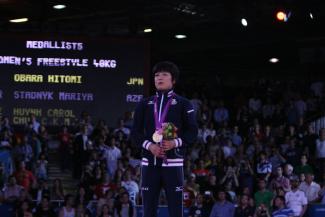
TOKYO (July 19) — Legendary Japanese wrestler Hitomi OBARA, the 2012 London Olympic gold medalist at women's 48kg and an eight-time world champion, passed away on Friday, the Japanese media reported on Saturday. She was 44.

The Japan Self-Defense Force Physical Training School, where Obara was a women's coach, said it was withholding the cause of death "out of consideration for the privacy and emotions of the bereaved family," according to The Yomiuri Shimbun.

Obara, the mother of two elementary school-aged children, was a director in the Japan Wrestling Federation, and had just been appointed in June as a coach of the women's national team for the run-up to the 2028 Los Angeles Olympics along with fellow former Olympic champion Kaori ICHO.

Obara, who won six of her world titles at 51kg under her maiden name of SAKAMOTO, became a model case for the ups and downs of high-level sports and the ability to overcome grave disappointment. Her victory at the London Olympics, at age 31, came after being denied spots on Japan's team at both of the two previous Olympics by fellow legend Saori YOSHIDA.

Born in 1981 in the wrestling hotbed of Hachinohe, Aomori Prefecture, in northern Japan, Obara went on to attend Chukyo University (now Shigakkan), which she helped turn into a national powerhouse along with Yoshida and fellow Hachinohe native Icho.

"It's hard, it's hard, I can't keep from crying," former Shigakkan and national team coach Kazuhito SAKAE was quoted as telling the Japanese media. "She was a wrestling prodigy. At the least, she was a hard worker with a strong sense of responsibility. She was wrestling's heaven-sent child. I still can't believe it." 

Obara won back-to-back world 51kg titles in 1999 and 2000. A serious knee injury would keep her from returning to the world championships until 2005, from which she won four in a row.

In between, she attempted to make the Japanese's squad to the 2004 Athens Olympics, but that dream ended with a loss by fall to Yoshida in the 55kg final at the All-Japan Championships in December 2002. She would only compete once in 2003 before returning in earnest in 2004 and beginning her streak of world titles the following year.

But more disappointment came her way in the qualifying process for the 2008 Beijing Olympics. Again it was Yoshida who squashed her dreams, beating her 2-0 (2-0, 4-0) in the 2006 All-Japan final. After the match, Obara sat for hours sobbing in a corner of the warm-up room, a towel draped over her head.

Obara managed to rebound from the defeat to win a playoff for the 51kg spot at the 2007 World Championships, where she won gold No. 5. After adding No. 6 a year later with a run to the gold that included a victory over future Olympic champ Helen MAROULIS (USA), she decided to retire.

But despite all of her success, the lack of a Olympic gold -- or even an appearance, for that matter -- still left a sting that would not abate. That, and the decision of her younger sister Makiko to retire, led her to attempt the difficult path of cutting down to 48kg to make it to London.

Makiko was a world bronze medalist at 48kg in 2005 and 2008, but decided to end her career after placing eighth in 2009. Hitomi had never wanted to displace her sister from the national team, but now the door to 48kg was open.

Her biggest battle may have been with the scale. On the mat, she was as unbeatable as ever, storming to world golds in 2010 and 2011 -- now as Obara after getting married in 2010.

There was one slip-up along the way -- a semifinal loss to So Sim HYANG (PRK) at the 2010 Asian Games that ended her 70-match winning streak in international matches. But she regained her confidence with a decisive win at the All-Japan, and it was with a full head of steam that she headed to the London Olympics, which she had announced would be her swan song.

In London, Obara knocked off defending Olympic champion Carol HUYNH (CAN) in the semifinals before coming from behind in the final to defeat Mariya STADNIK (AZE) 2-1 (0-4, 1-0, 2-0) -- a replay of the gold-medal match at the 2011 worlds.

"If you keep doing what you love and never give up, you can achieve your dream," Obara told students at the junior high school she attended during a visit in January last year.

Upon retiring, Obara joined the staff at the Self-Defense Force Physical Training School, where she was also an officer. Among the members she coached were Haruna MURAYAMA OKUNO, Himeka TOKUHARA and Masako FURUICHI, who all made Japan's team to this year's World Championships.

In 2022, Obara was inducted into UWW's Hall of Fame along with Yoshida and Icho.