#UnitedWorldWrestling

Julfalakyan re-elected as UWW Athletes' Commission President

By United World Wrestling Press

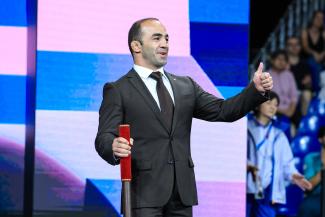
CORSIER-SUR-VEVEY, Switzerland (October 1) -- Arsen JULFALAKYAN has been re-elected President of the United World Wrestling Athletes’ Commission, securing a second term from 2025 to 2029.

The London Olympic silver medalist, who first took office in 2021, was the sole candidate for the position following the Athletes’ Commission elections held during the World Championships in Zagreb.

As President of the Commission, Julfalakyan will serve as the voice of wrestlers and represent their interests at the UWW Bureau and Congress. He will also represent athletes at the IOC Athletes’ Forum, WADA, and other international organizations.

"I am grateful to the entire wrestling community for trusting me with the privilege of representing them in the UWW Bureau and on the world stage," Julfalakyan said. "I’ll do my best to carry out this mission with dignity and ensure your voice is heard worldwide.

“Special thanks to UWW President Nenad Lalovic, Bureau members, and all national federations for their support. I would also like to take this opportunity to strongly encourage wrestlers to stay actively engaged with the UWW Athletes’ Commission.”

The elections for the Athletes' Commission were held during the World Championships in Zagreb from September 12 to 20 in which nine members, including four women, were elected. These nine members are:

Arsen JULFALAKYAN (ARG)
Yui SUSAKI (JPN)
Tamas LORINCZ (HUN)
Aisuluu TYNYBEKOVA (KGZ)
Hassan YAZDANI (IRI)
Maria PREVOLARAKI (GRE)
Abdellatif MOHAMED (EGY)
Jessica LAVERS-McBAIN (AUS)
Nicolaas DE LANGE (RSA)

Following the election, UWW called for candidates for the presidency. As the sole applicant, Julfalakyan was elected unopposed and will continue as President of the Athletes’ Commission. UWW congratulates Julfalakyan on his re-election.

For any queries regarding the election or the functioning of the Athletes Commission, please contact UWW Secretariat.

#development

South Africa completes phase one of UWW DNSS Program

By United World Wrestling Press

PRETORIA, South Africa (November 17) --  The South African Wrestling Federation successfully completed the first phase of the United World Wrestling National Development and Support Strategy (DNSS) from October 17 to 26.

Under the supervision of Vincent AKA, UWW International Development Officer for Africa, and the coordination of Markus DEKKER, member of the SAWF Coaches Council, a nationwide development mission was undertaken. The UWW-SAWF team visited provincial associations, conducting technical assessments, talent identification sessions, and workshops for coaches.

South Africa

Using the UWW National Federation Assessment Tool (NFAT), the mission provided a detailed overview of the current state of wrestling in South Africa -- from grassroots participation to elite athlete preparation.

The tour covered major provinces including Western Cape, Eastern Province, Free State, Northern Cape, Gauteng North, Limpopo, Mpumalanga, and North West, engaging hundreds of athletes, coaches, and local administrators.

The assessment revealed strong technical potential among the U15 and U17 categories, as well as a growing passion for wrestling across communities and schools.

The mission also identified the need for stronger governance structures and more consistent communication between SAWF, provinces, and clubs to unify efforts under a national development plan.

Both teams will continue to work towards second phase of the program which will include establishing two regional pilot centers [Pretoria and Western Cape] to act as training and coordination hubs, launch a "School Integration" program linking PE teachers, schools, and wrestling clubs, developing a national athlete database to monitor and support emerging talents.

It will also aim to organize governance and compliance workshops to reinforce management capacity, implementing UWW coaching courses nationwide, forming a National Technical Committee to coordinate DNSS implementation and introducing measurable evaluation indicators to ensure accountability and progress tracking.